By using this site, you agree to the Privacy Policy and Terms of Use.
Accept
Media HydeMedia Hyde
  • Home
  • Politics
  • Education
  • Entertainment
  • Sports
  • Blogs
  • Business & Commerce
  • Others
    • Religious
    • Metropolitan
    • Climate and Weather
Font ResizerAa
Media HydeMedia Hyde
Font ResizerAa
  • Home
  • Politics
  • Education
  • Entertainment
  • Sports
  • Blogs
  • Business & Commerce
  • Others
    • Religious
    • Metropolitan
    • Climate and Weather
Follow US
© 2026 Media Hyde Network. All Rights Reserved.
Blog

“Roots of Change” Fixing Primary Education in Pakistan

Last updated: July 2, 2025 12:56 am
Sana Mustafa
Share
SHARE

Why Pakistan’s Primary Education System Needs Urgent Attention And How We Can Fix It?

“A Child’s First Step Should  Be Strong”

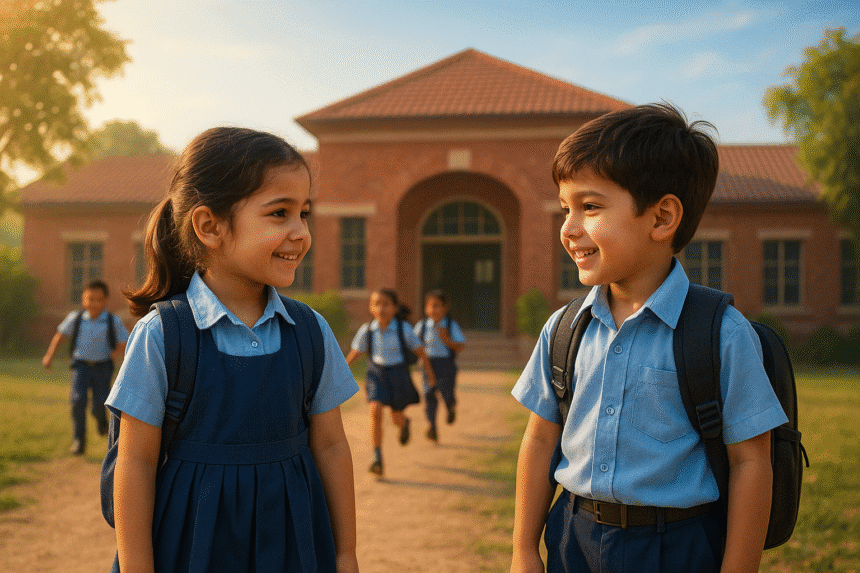
Every great journey begins with a single step  and in a child’s life, that first step is primary education. It’s the foundation of reading, writing, counting, and understanding the world. But sadly, in Pakistan, millions of children are not getting the quality primary education they deserve.

This blog will highlight the main problems of Pakistan’s primary education system, explore the reasons behind them, and offer simple, practical suggestions for improvement because when our children learn well, our country grows stronger.

The Real Picture:

What’s Wrong With Primary Education in Pakistan?

Many primary school teachers lack proper training.Some teachers are not even clear about how to teach young minds basic skills like reading or writing.

In rural areas, there are cases of “ghost teachers” those who never show up at school.

Result: Children don’t learn in a proper way. Their basics remain weak.


Many schools don’t have clean drinking water, toilets, or desks.Some schools are run in open spaces or broken buildings.There is no electricity or fans in many schools.

Result: Kids find it hard to focus or even attend school, especially girls.


Books are old fashioned and full of hard language.Children are forced to memorize instead of understanding. Creativity and critical thinking are missing from the learning process.

Result: Students may pass exams but don’t learn real-life skills.


Some schools teach in Urdu, others in English, and some even in regional languages.Children get confused and struggle to learn.

Result: Children can’t develop strong communication skills in any language.


Over 22 million children in Pakistan are out of school (UNESCO, 2023).Many kids drop out due to poverty, child labor, early marriages, or lack of transport.

Result: These children grow up without the skills to succeed in life or contribute to the country.


Girls in many rural and tribal areas are not allowed to go to school.Schools for girls are fewer and often far away. Parents prefer to invest in boys’ education, not girls’.

Result: Half of our population stays uneducated, leading to long-term social problems.


Private schools offer better education, but they’re expensive.Government schools are affordable, but most are under-resourced.

Result: Poor children get low-quality education, creating education inequality.


What Can Be Done?

Practical Suggestions for Change We can fix the broken system

1. Train the Teachers Regularly

Make teacher training compulsory.Use modern teaching methods like storytelling, group activities, and digital tools.

2. Upgrade School Infrastructure

Ensure safe buildings, clean water, toilets, electricity, and playgrounds. Provide transport for children in remote areas.

3. Revise the Curriculum

Make the syllabus child-friendly, easy-to-read, and activity-based.Teach through games, pictures, and practical examples.

4. Focus on Early Reading and Writing

Make reading and writing the heart of primary education.Let children express themselves through writing and drawing.

5. Promote One Clear Language Policy

Decide on one simple language (Urdu or regional) for primary levels. Add basic English gradually.

6. Bring All Children to School

Run free meal programs, cash support for parents, and awareness campaigns. Encourage girls’ education by building safe, nearby girls’ schools.

7. Use Technology for Better Learning

Use mobile apps, TV lessons, and digital blackboards.Record teacher lessons to monitor and improve quality.

A Nation Rises When Its Children Learn

If a child cannot read a simple sentence, how will they understand the world? If a child cannot write their name, how will they write their future?

If children are not taught the basics of respect, logic, and language, how will they build a strong and peaceful society?

Primary education is not just about books and exams  it’s about building the future of Pakistan. If we fix the roots, our tree of knowledge will grow tall and give fruit for generations.

Let us invest in our children, give them the right start, and watch them shine.

 Remember: Every child can learn. Every child deserves to learn.

 

Share This Article
Email Copy Link Print
Previous Article UK Police Launch Probe After Anti-Is*ael Chants at Glastonbury Music Festival
Next Article Petrol Prices in Pakistan from July 1, 2025
Leave a Comment

Leave a Reply Cancel reply

Your email address will not be published. Required fields are marked *

Sponsored Ads

Stay Connected

FacebookLike
XFollow
InstagramFollow
YoutubeSubscribe
WhatsAppFollow
ThreadsFollow
Sindh Schools to Close for Two-Month Summer Break Starting June 1
Education
May 13, 2026
Pakistan Targets Tech Workforce with 20,000 AI Training Slots
Education
May 13, 2026
Tokyo University Launches Fully Autonomous Lab Where Robots Run the Show The lights are on at the University of Tokyo’s newest chemistry lab, but the lab coats are gone. In a move that signals a shift for experimental science, the university has officially opened a facility where robots handle the entire research cycle—from mixing chemicals to analyzing results—without a single human in the room. This isn’t just a room with a few automated arms. It’s a closed-loop system designed to hunt for new materials for batteries and semiconductors at speeds that make traditional methods look like they’re standing still. The AI designs the experiment, the robots execute it, and the data feeds right back into the AI to decide what happens next. "The goal is to remove the bottleneck of human physical labor," a researcher involved in the project’s pilot phase said. "A human can do maybe ten experiments a day. This system won't stop at ten, and it doesn't need to go home at 5:00 PM." The stakes are high. Japan is currently locked in a global race to find more efficient materials for the next generation of electric vehicle batteries. By cutting humans out of the "pipette-and-wait" cycle, the university expects to compress years of trial-and-error into a few weeks of non-stop robotic iteration. It’s a response to a looming crisis, too. Japan’s shrinking workforce means there are fewer young scientists entering the field every year. Automating the grunt work isn't just about speed; it’s about survival in a country where human talent is becoming a scarce resource. Critics often worry that "robot-run" means "job-lost," but the university’s lead engineers argue the opposite. They say the move frees up researchers to actually think, rather than spending eight hours a day performing repetitive liquid handling. The robots don't get bored, they don't make clerical errors, and they don't suffer from "Friday afternoon" fatigue that can ruin a data set. The lab is currently focused on thin-film materials, but the team plans to scale the technology to other branches of chemistry soon. If it works, the image of the lone scientist hunched over a workbench might soon be a relic of the past. The lab is running right now. It’ll be running tomorrow morning. And it won't need a coffee break to get through the night.
Tokyo University Launches Fully Autonomous Lab Where Robots Run the Show
Education
May 13, 2026
Pakistan Offers New Higher Education Scholarships to Bangladeshi Students
Education
May 13, 2026
Private Schools Defy Punjab Government’s Revised Summer Vacation Schedule
Education
May 13, 2026
HEC Drops Paperwork: Fully Online Degree Attestation Goes Live Nationwide
Education
May 13, 2026

You Might Also Like

Blog

Plastic Waste Gets New Life in Japan

By
Sana Mustafa
Blog

Why Red Flags Fly Over Holy Shrines of imam Hussain A.S and Hazrat Abbas A.S and Mosques After Israel’s Attack on Iran

By
Wajeeha Batool
Blog

Terror Triangle: Taliban, TTP and BLA

By
Sana Mustafa
Blog

Headline: Jaffer Express: A Journey Defined by Decay and Danger

By
Ayan Ahmed
Media Hyde Media Hyde Dark
Facebook Twitter Youtube Rss Medium

About US

Media Hyde Network: Your instant connection to breaking stories and live updates. Stay informed with our real-time coverage across politics, tech, entertainment, and more. Your reliable source for 24/7 News.

Top Categories
  • Headline
  • Politics
  • Entertainment
  • Education
  • Sports
  • Religious
  • Metropolitan
  • Climate and Weather
Usefull Links
  • Contact Us
  • Disclaimer
  • Privacy Policy
  • Cookies Policy
  • Advertising Policy
  • Terms & Conditions

© 2025 Media Hyde Network. All Rights Reserved.

Welcome Back!

Sign in to your account

Username or Email Address
Password

Lost your password?