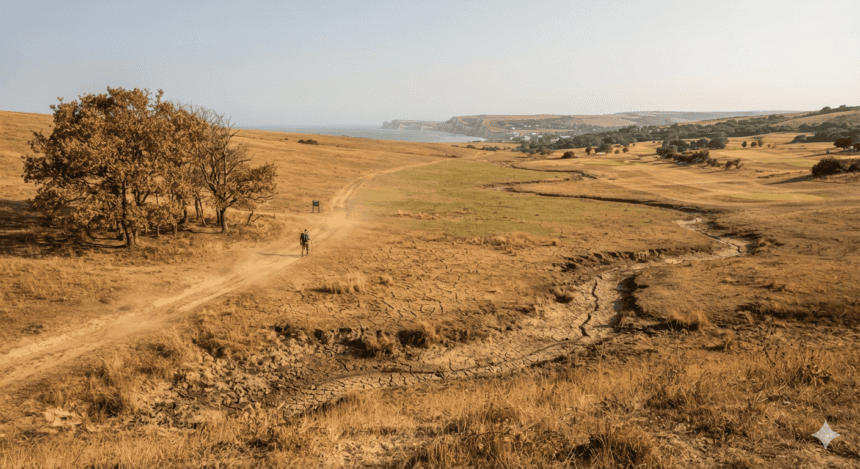
England’s landscape is losing its signature green hue. Satellite data from the European Space Agency’s Copernicus program shows vast swaths of the country shifting to a parched, straw-brown color, a stark shift from the lush fields typical of a British summer.
The transformation is most visible across the southeast and the Midlands. What were once vibrant pastures have succumbed to weeks of record-breaking heat and the driest July in over 80 years. Soil moisture levels have plummeted, leaving farmers scrambling to irrigate crops that are already showing signs of heat stress.
The impact stretches beyond the countryside. Water companies are facing mounting pressure to implement hosepipe bans as reservoirs drop to their lowest levels since the mid-90s. While some regions have seen sporadic rainfall, it hasn’t been enough to soak into the baked, hardened ground. Instead, the water simply runs off, providing little relief to the parched earth below.
“We are seeing a landscape under significant thermal stress,” said a climate analyst familiar with the satellite data. “The brown you see isn’t just a seasonal shift; it’s an early indicator of deep-seated moisture deficit.”
The government’s National Drought Group has moved several regions into “official drought” status. This isn’t just a label. It triggers emergency protocols that force utility providers to prioritize essential supplies over garden hoses and car washes.
Farmers are particularly exposed. With autumn planting seasons approaching, the inability to work the soil—which is currently as hard as concrete—threatens the next cycle of winter wheat and barley. If the ground doesn’t soften soon, the economic ripple effects will be felt at the supermarket checkout by late winter.
The drought is no longer a localized issue for gardeners or water-conscious households. It is a fundamental shift in the environment that is testing the limits of England’s infrastructure. As the heat continues to hold, the question remains: can the country’s water management systems adapt fast enough to handle a future where this brown landscape becomes the new normal?