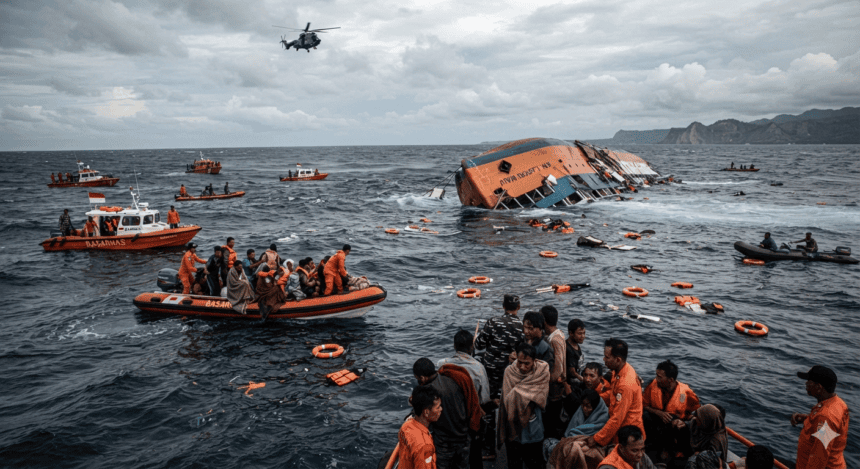
A passenger ferry capsized in the early hours of Wednesday off the coast of Indonesia’s South Sulawesi province, leaving at least six people dead and 130 others missing. Search and rescue operations are currently battling heavy swells and high winds that have hampered efforts to reach the vessel’s wreckage.
The ship, identified as the *KM Lestari*, was roughly 300 meters from the shore of Selayar Island when it began taking on water. Survivors reported that the vessel started listing sharply before overturning, throwing passengers into the turbulent Makassar Strait.
Local authorities confirmed that 64 survivors have been pulled from the water so far. Most were found clinging to debris or life rafts, though the rough conditions have made it difficult for rescue boats to navigate the site.
“We are racing against time and the weather,” said Muhammad Syaugi, head of the national search and rescue agency. “The wind is fierce and the waves are hitting five meters high, which is making it nearly impossible for our divers to get a clear look at the hull.”
The ferry was carrying a mix of passengers, motorcycles, and cargo. Preliminary reports suggest the vessel suffered a hull breach, though the exact cause of the capsizing remains under investigation. Maritime safety inspectors are already questioning whether the ship was overloaded, a recurring issue in Indonesia’s vast archipelago where ferries serve as the primary mode of transportation.
Families of the missing have gathered at the port in Bulukumba, waiting for news as the list of confirmed casualties grows. Local hospitals in Selayar are currently treating the survivors, many of whom are suffering from hypothermia and shock.
This tragedy marks the second major maritime accident in the region within a week. Only days ago, a separate ferry sank in Lake Toba, North Sumatra, resulting in dozens of deaths.
As night falls over the Makassar Strait, search efforts have been scaled back due to visibility concerns, with rescue teams expected to resume an intensive sweep at first light. For the families waiting on the shore, the uncertainty of the coming hours remains the most agonizing part of the disaster.