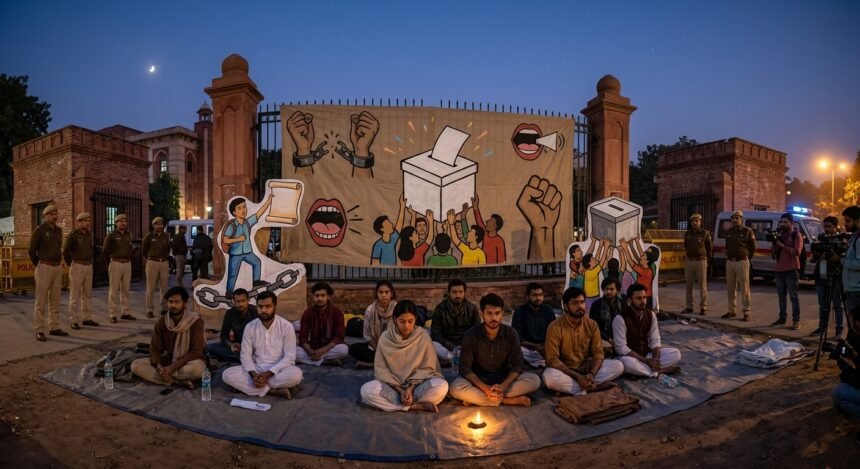
Students at several major Indian universities have launched hunger strikes, pushing back against what they call the systematic erosion of democratic spaces on campus. The protests, centered at institutions like Allahabad University and various state-run colleges, demand the immediate restoration of elected student unions—bodies that have been suspended or dissolved by administrations for years.
The strikes aren’t just about campus politics. For these students, the union is the only firewall against arbitrary fee hikes and administrative overreach. Without an elected voice, students say they are left with no formal channel to challenge university policies.
“They treat us like children, not stakeholders,” said a student leader at Allahabad, where the hunger strike has entered its sixth day. “When the administration decides to hike hostel fees overnight, there is no one to hold them accountable. That is why we are on the streets.”
University administrations often cite “law and order” concerns to justify banning elections. They argue that campus politics frequently devolves into violence or disrupts academic calendars. But critics view this as a convenient excuse to curb dissent. The Lyngdoh Committee recommendations, which govern student elections in India, are often invoked by officials to disqualify candidates or delay polls indefinitely, effectively paralyzing student activism.
The silence from the Ministry of Education has only fueled the frustration. While university officials maintain that they are following “procedural protocols,” the students see a coordinated effort to depoliticize higher education.
The standoff shows no signs of cooling. As health conditions of the fasting students deteriorate, the pressure on university vice-chancellors is mounting. Whether the administrations will concede to demands for elections or continue to treat student representation as a threat remains the defining question of this academic year.
For now, the hunger strikes serve as a stark reminder: when formal channels for grievance are closed, the campus floor becomes the only place left to be heard.