By using this site, you agree to the Privacy Policy and Terms of Use.
Accept
Media HydeMedia Hyde
  • Home
  • Politics
  • Education
  • Entertainment
  • Sports
  • Blogs
  • Business & Commerce
  • Others
    • Religious
    • Metropolitan
    • Climate and Weather
Font ResizerAa
Media HydeMedia Hyde
Font ResizerAa
  • Home
  • Politics
  • Education
  • Entertainment
  • Sports
  • Blogs
  • Business & Commerce
  • Others
    • Religious
    • Metropolitan
    • Climate and Weather
Follow US
© 2026 Media Hyde Network. All Rights Reserved.
Climate and WeatherHeadline

The ‘Gates to Hell’ Are Dimming. That May Not Be a Good Thing.

Last updated: May 4, 2026 10:02 pm
Ayesha Masood
Share
The ‘Gates to Hell’ Are Dimming. That May Not Be a Good Thing.
SHARE

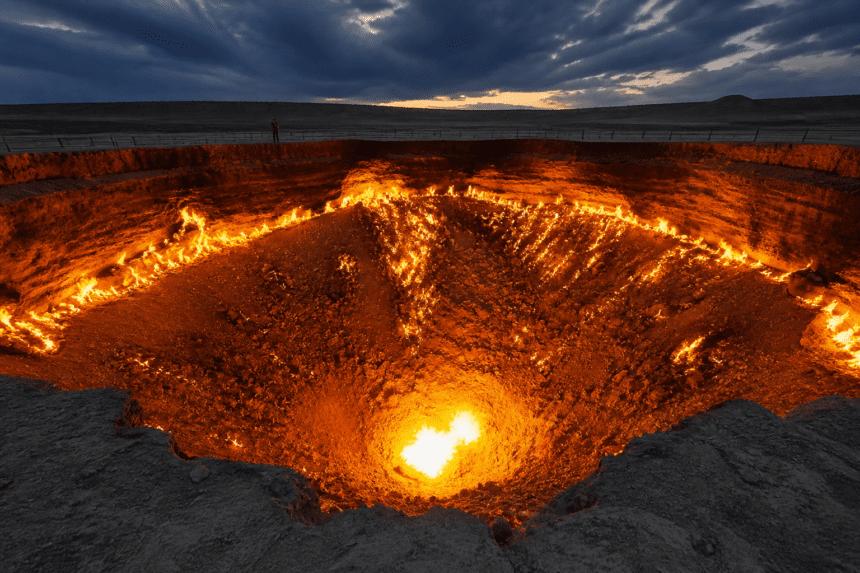
Turkmenistan’s famous Darvaza gas crater, widely known as the “Gates to Hell,” is no longer burning with the same intensity that made it one of the world’s strangest tourist landmarks. Recent reporting says the fire is now only a fraction of its former size, after nearby drilling and gas-capture efforts reduced the flow of methane feeding the crater.

At first glance, that sounds like progress. The crater has long symbolized waste, danger, and environmental neglect, so a smaller flame might seem like a straightforward win. But the concern is that a dimmer fire does not necessarily mean the methane problem has been solved. If less gas is reaching the crater, that can mean it is being captured — but it can also mean emissions are escaping elsewhere, becoming less visible while still harming the climate.

That is why the story matters beyond tourism or spectacle. Methane is one of the most powerful greenhouse gases, trapping far more heat than carbon dioxide over the short term. Turkmenistan has repeatedly drawn international attention for large methane leaks detected by satellite, which means the real question is not whether the crater looks smaller, but whether overall emissions are actually falling in a measurable way.

The Darvaza crater was never just a curiosity in the desert. It became a symbol of a much larger energy problem: gas escaping, burning wastefully, and turning environmental damage into a permanent fire. If that fire is fading because methane is finally being controlled, that would be meaningful progress. But if the fuel is simply being rerouted or leaking less visibly, then the dimming may be more cosmetic than corrective.

So the warning in the headline is fairly simple: a weaker flame looks better, but appearances can mislead. What matters is not how dramatic the crater still seems, but whether the underlying methane emissions are truly being reduced.


Share This Article
Email Copy Link Print
Previous Article Pakistan’s Overseas Employment Bureau Issues New Security Checklist for Job Seekers
Next Article LHC suspends defamation case verdict against Meesha Shafi to the extent of payment of damages LHC suspends defamation case verdict against Meesha Shafi to the extent of payment of damages
Leave a Comment

Leave a Reply Cancel reply

Your email address will not be published. Required fields are marked *

Sponsored Ads

Stay Connected

FacebookLike
XFollow
InstagramFollow
YoutubeSubscribe
WhatsAppFollow
ThreadsFollow
Sindh Schools to Close for Two-Month Summer Break Starting June 1
Education
May 13, 2026
Pakistan Targets Tech Workforce with 20,000 AI Training Slots
Education
May 13, 2026
Tokyo University Launches Fully Autonomous Lab Where Robots Run the Show The lights are on at the University of Tokyo’s newest chemistry lab, but the lab coats are gone. In a move that signals a shift for experimental science, the university has officially opened a facility where robots handle the entire research cycle—from mixing chemicals to analyzing results—without a single human in the room. This isn’t just a room with a few automated arms. It’s a closed-loop system designed to hunt for new materials for batteries and semiconductors at speeds that make traditional methods look like they’re standing still. The AI designs the experiment, the robots execute it, and the data feeds right back into the AI to decide what happens next. "The goal is to remove the bottleneck of human physical labor," a researcher involved in the project’s pilot phase said. "A human can do maybe ten experiments a day. This system won't stop at ten, and it doesn't need to go home at 5:00 PM." The stakes are high. Japan is currently locked in a global race to find more efficient materials for the next generation of electric vehicle batteries. By cutting humans out of the "pipette-and-wait" cycle, the university expects to compress years of trial-and-error into a few weeks of non-stop robotic iteration. It’s a response to a looming crisis, too. Japan’s shrinking workforce means there are fewer young scientists entering the field every year. Automating the grunt work isn't just about speed; it’s about survival in a country where human talent is becoming a scarce resource. Critics often worry that "robot-run" means "job-lost," but the university’s lead engineers argue the opposite. They say the move frees up researchers to actually think, rather than spending eight hours a day performing repetitive liquid handling. The robots don't get bored, they don't make clerical errors, and they don't suffer from "Friday afternoon" fatigue that can ruin a data set. The lab is currently focused on thin-film materials, but the team plans to scale the technology to other branches of chemistry soon. If it works, the image of the lone scientist hunched over a workbench might soon be a relic of the past. The lab is running right now. It’ll be running tomorrow morning. And it won't need a coffee break to get through the night.
Tokyo University Launches Fully Autonomous Lab Where Robots Run the Show
Education
May 13, 2026
Pakistan Offers New Higher Education Scholarships to Bangladeshi Students
Education
May 13, 2026
Private Schools Defy Punjab Government’s Revised Summer Vacation Schedule
Education
May 13, 2026
HEC Drops Paperwork: Fully Online Degree Attestation Goes Live Nationwide
Education
May 13, 2026

You Might Also Like

Climate and Weather

Flood Hit GB Rebuilds with Hope and Unity

By
Sana Mustafa
EconomyHeadline

Oil Prices Spike as Market Weighs Iran-U.S. Tensions

By
Haris Ali
Climate and Weather

Karachi Enjoys Breezy Weather with Chances of Light Rain Ahead

By
Sana Mustafa
Climate and Weather

Saudi Arabia Enhances Heat Safety Measures as Hajj Pilgrimage Begins in Extreme Heat

By
Sana Mustafa
Media Hyde Media Hyde Dark
Facebook Twitter Youtube Rss Medium

About US

Media Hyde Network: Your instant connection to breaking stories and live updates. Stay informed with our real-time coverage across politics, tech, entertainment, and more. Your reliable source for 24/7 News.

Top Categories
  • Headline
  • Politics
  • Entertainment
  • Education
  • Sports
  • Religious
  • Metropolitan
  • Climate and Weather
Usefull Links
  • Contact Us
  • Disclaimer
  • Privacy Policy
  • Cookies Policy
  • Advertising Policy
  • Terms & Conditions

© 2025 Media Hyde Network. All Rights Reserved.

Welcome Back!

Sign in to your account

Username or Email Address
Password

Lost your password?