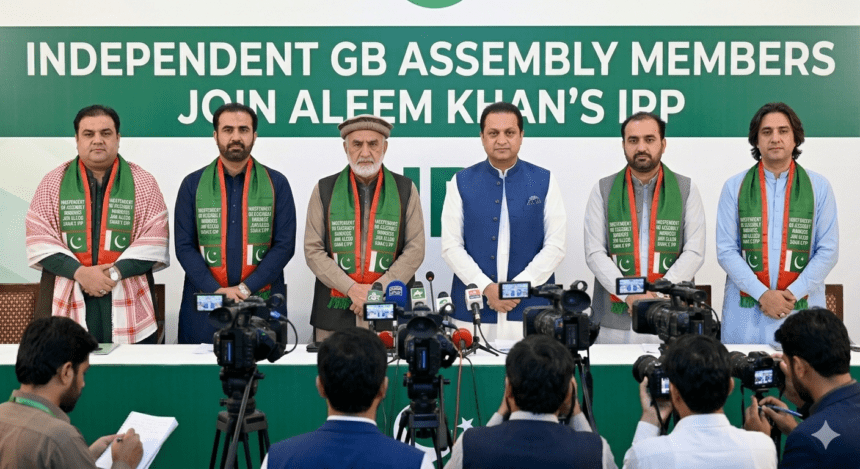
GILGIT — Three independent members of the Gilgit-Baltistan Assembly have formally joined the Istehkam-e-Pakistan Party (IPP), shifting the region’s fragile political landscape. The move signals a strategic realignment as the IPP looks to solidify its footprint beyond Punjab.
The lawmakers — Javed Ali Manwa, Mushtaq Hussain, and Abdul Hamid — announced their decision after a series of meetings with IPP leadership in Islamabad. Their shift brings a new layer of complexity to the assembly, where independent candidates have historically held the balance of power.
For the IPP, the induction is a calculated play. Since its formation, the party has struggled to shed the perception that its influence is limited to central Pakistan. By securing representation in the GB Assembly, party chief Aleem Khan gains a foothold in a strategically vital region, one where federal influence often dictates the pace of development projects and local governance.
Political analysts in Gilgit suggest the move is less about ideology and more about pragmatism. Independent members often struggle to secure development funds or ministerial portfolios without the backing of a registered political entity. Aligning with a party that maintains close ties to the federal establishment offers these lawmakers a direct line to Islamabad—a luxury they lacked as independents.
The timing is telling. The GB government has faced mounting pressure over electricity shortages and wheat subsidy cuts. By aligning with the IPP, these members are betting that their new affiliation will grant them the political leverage needed to navigate these crises and deliver results for their constituencies before the next budget cycle.
Opposition figures in the assembly have already criticized the move, labeling it a “transactional deal” that undermines the mandate given to independent candidates. They argue that voters supported these individuals specifically because they were not tied to the agendas of mainstream political parties.
Whether this move brings tangible relief to the people of Gilgit-Baltistan remains the central question. For now, the IPP has a presence in the north, and the three lawmakers have a new platform to navigate the region’s shifting political currents.
The immediate test for this new alliance will be the upcoming assembly session, where the government’s ability to pass critical legislation will depend on whether this transition translates into a stable, working majority.