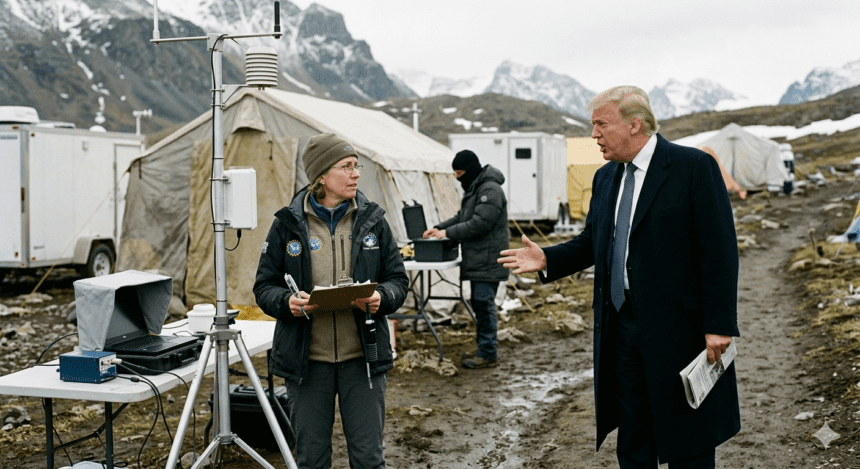
Donald Trump wasted no time dismissing the latest climate projections from the National Oceanic and Atmospheric Administration (NOAA) this week. The agency released a revised outlook suggesting global temperatures are tracking toward a more aggressive warming trajectory than previously estimated, prompting the former president to label the findings a “political setup.”
Trump, speaking at a campaign rally in Pennsylvania, claimed the data was manipulated to justify stricter environmental regulations. “They’re changing the numbers again,” he told the crowd. “It’s a hoax, and they’ll do anything to stop our energy dominance.”
The NOAA update, published Tuesday, incorporates new ocean heat absorption data that suggests a 0.2-degree Celsius increase in expected warming by 2050. Researchers spent three years recalibrating their models to account for shifting current patterns in the Atlantic and Pacific, which they say have been cooling the atmosphere more than historical averages suggested.
Climate scientists argue the revision is a standard technical adjustment, not a policy-driven pivot. “We didn’t change the climate; we improved our ability to measure it,” said Dr. Sarah Jenkins, a lead author on the report. “The physics hasn’t changed. Our sensors have simply become more precise.”
The political friction centers on the economic implications of these findings. While the scientific community views the data as a roadmap for infrastructure adaptation, the Trump camp views it as a direct threat to domestic fossil fuel production. His advisors have already signaled that a second term would involve dismantling the current administration’s reliance on such models for executive rulemaking.
The reality of the situation is that the baseline remains grim, regardless of the political spin. Whether the warming is calculated at one level or another, the infrastructure costs for coastal cities continue to climb.
Trump’s rhetoric effectively creates a wall between the data and the electorate. By positioning the scientists as partisan actors, he shifts the conversation away from the heat itself and onto the integrity of the institutions measuring it.