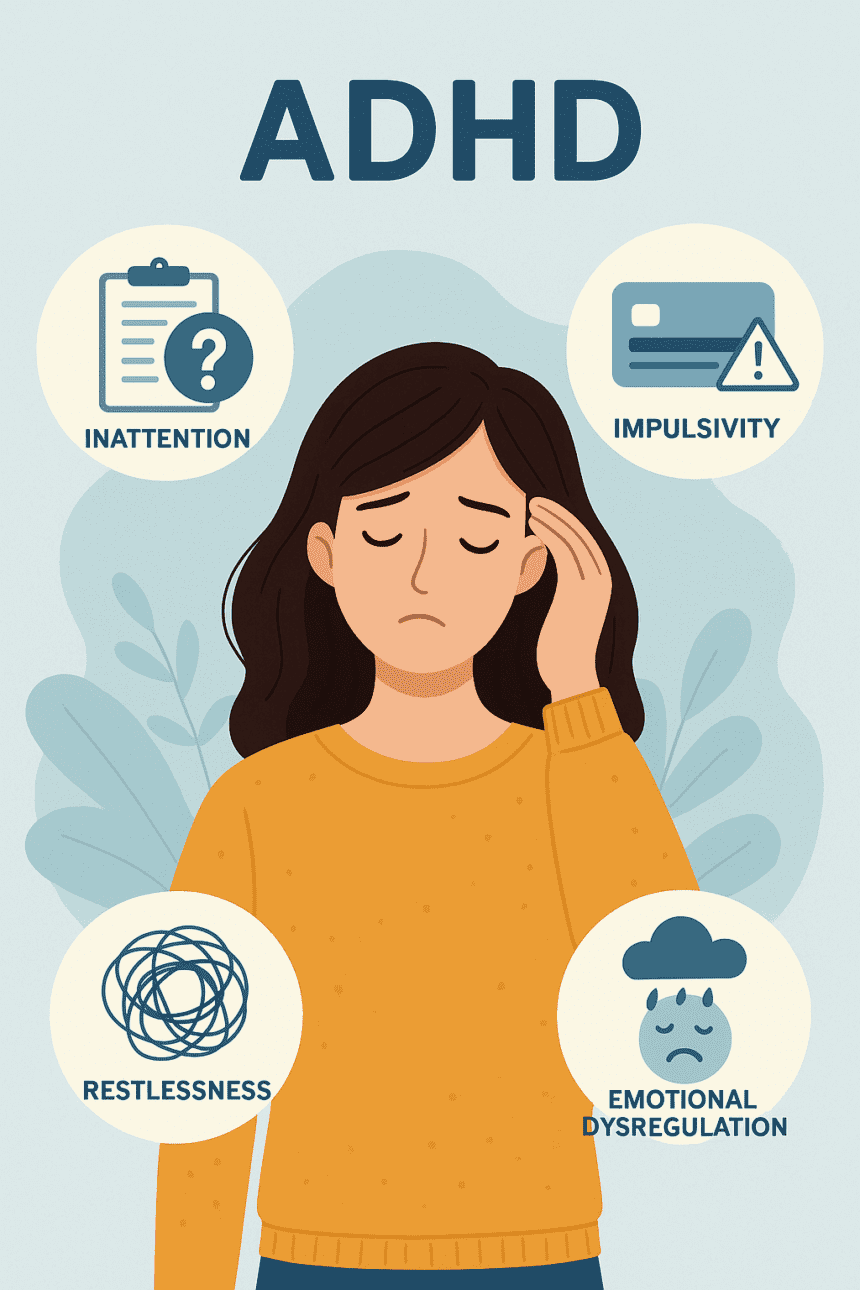
For decades, the medical community viewed ADHD as a disorder of hyperactive young boys. That narrow lens left millions of women undiagnosed, struggling to mask symptoms while being told they were simply disorganized, overly emotional, or anxious. The data confirms the oversight.
While boys are often flagged for disruptive behavior in classrooms, girls frequently internalize their symptoms.
By the time many women reach their thirties or forties, they aren’t seeking help because they can’t sit still; they’re seeking help because their “internal engine” has finally burned out. “It’s not that we aren’t trying,” said Sarah Jenkins, a clinical psychologist specializing in adult neurodivergence. “We’ve spent decades using every ounce of cognitive energy just to appear normal. That’s not laziness. That’s exhaustion.
” The diagnostic gap is widening. Because adult women often present with inattentive-type ADHD rather than the hyperactive-impulsive traits typical in children, standard screening tools often miss them.
Instead of a diagnosis, these women are frequently prescribed antidepressants or anti-anxiety medication treatments that address the secondary symptoms but leave the root cause untouched.
This cycle of misdiagnosis carries a heavy price. Women with undiagnosed ADHD report significantly higher rates of burnout, job instability, and chronic self-doubt.
The social expectation to manage the “mental load” maintaining a home, a career, and a social calendar disproportionately penalizes those whose executive functions don’t operate on a traditional neurotypical clock.
The shift in discourse is overdue.
Modern research now emphasizes that ADHD in women often manifests as chronic procrastination, emotional dysregulation, and sensory overload. It is a brain-based difference in how dopamine is processed, not a character flaw.
As awareness grows, the medical establishment faces a reckoning.
The old stereotypes aren’t just inaccurate; they are actively preventing women from accessing the tools they need to function.
For those who spent years wondering why they felt different, a diagnosis is rarely just a labelit is the first time they realize the problem was never their character, but their chemistry.