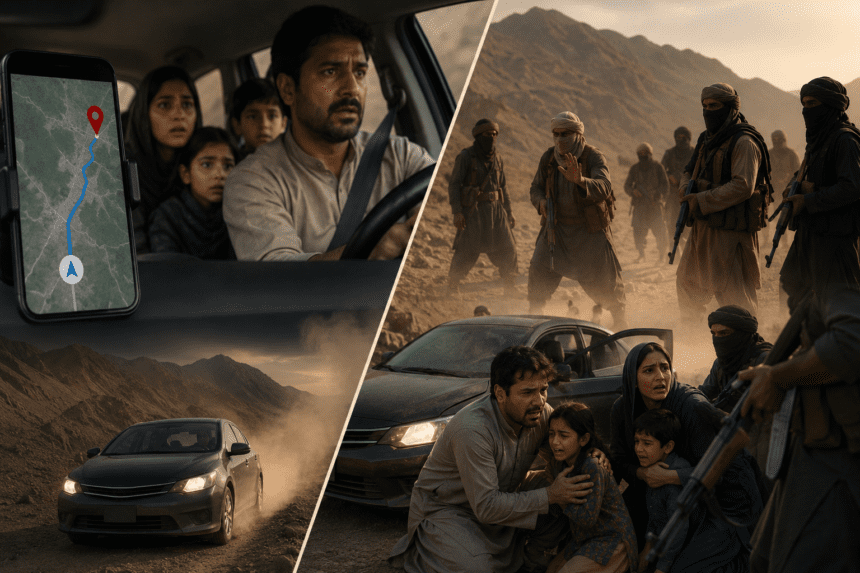
A routine road trip turned into a desperate fight for survival when a Karachi family, relying on Google Maps for a shortcut, was ambushed in a remote, lawless stretch of Balochistan. The family, traveling toward their destination, found themselves diverted onto an unpaved, desolate track by the navigation app—a path that led them straight into the crosshairs of local armed men.
The incident underscores a growing, often lethal, reliance on digital navigation in regions where technology lacks the ground-truth intelligence to account for tribal volatility.
As the vehicle slowed on the rugged terrain, unidentified gunmen intercepted the car. The attackers, operating in an area with minimal law enforcement presence, held the family at gunpoint, demanding valuables and cash. The victims, caught off guard in a location where cell service was non-existent, were unable to call for help.
Local authorities confirmed the family was eventually released, though they were stripped of their belongings, including cell phones and travel documents. The attackers vanished into the surrounding hills before police reached the scene.
“The map showed it as a viable road,” a relative told local reporters. “We trusted the technology because it’s what everyone uses now, but it took us into a place where the law simply doesn’t reach.”
This is not an isolated event. Security analysts have long warned that digital mapping services often prioritize the shortest distance between two points without factoring in the security landscape of Pakistan’s interior. In parts of Balochistan, “shortest route” algorithms frequently suggest abandoned mining tracks or tribal transit paths that are effectively controlled by criminal gangs or separatist factions.
Local police are now urging travelers to stick to main highways and avoid “shortcut” prompts that veer off the N-25 or the Coastal Highway. While the family escaped with their lives, the psychological toll of the encounter remains.
For now, the incident serves as a stark reminder: in the rugged terrain of Balochistan, a satellite signal is no substitute for local knowledge.