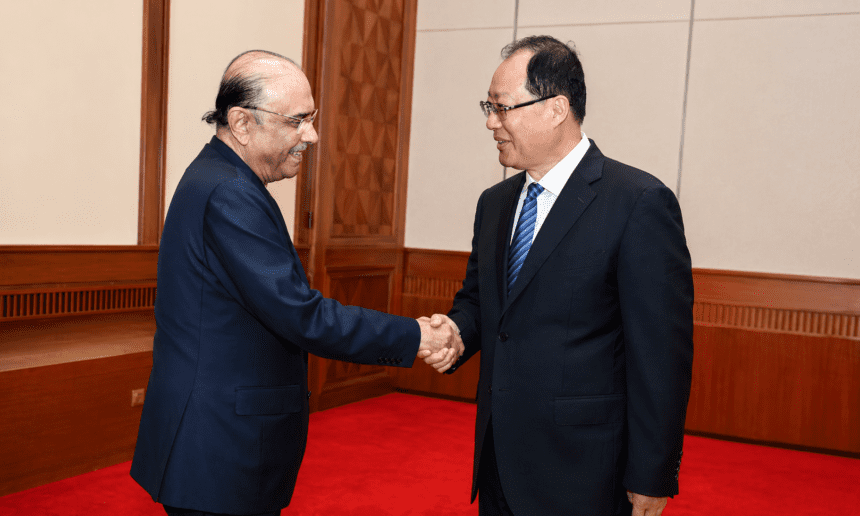
President Asif Ali Zardari on Wednesday urged Chinese investors to step up their footprint in Pakistan’s “priority sectors,” with a pretty clear emphasis on alternative energy, water treatment and electric vehicle battery systems, according to state media and local reporting. The appeal came during his meeting in Sanya with Wang Jian, the chief executive of Hangzhou Jinjiang Group.
The timing matters. Zardari is in China on an official visit running from April 25 to May 1, 2026, and Islamabad had already signaled before the trip that the main focus would be economic and trade cooperation, along with discussions linked to the China-Pakistan Economic Corridor, or CPEC. The Foreign Office said his itinerary included Changsha in Hunan from April 25 to 27 and Sanya in Hainan from April 28 to May 1.
That gives Wednesday’s meeting a wider frame. This was not just a courtesy call or a routine business sit-down. It fits into Pakistan’s broader attempt to pull in fresh Chinese capital at a time when the government is looking for investment that can ease structural pressure points in the economy, especially energy and industrial capacity. The sectors Zardari highlighted are telling: power diversification, water systems and EV-related manufacturing are all areas where Pakistan wants outside financing, technology and scale.
Officials in Islamabad have been leaning into that message for weeks. Earlier this month, Pakistan’s consul general in Shanghai invited Chinese firms to explore investment in a new batch of priority areas tied to what officials describe as CPEC’s “2.0” phase, including renewable energy and manufacturing. In other words, the pitch now is not only about roads and big-ticket infrastructure. It’s also about moving into cleaner energy, industrial upgrading and export-oriented production.
The Chinese angle is important too. Pakistan has long described CPEC as the cornerstone of its economic partnership with China, and the Foreign Office says the corridor’s first decade brought progress in energy, transport infrastructure and socio-economic development. That history gives Islamabad something concrete to point to when it asks Chinese companies to expand into newer sectors.
For Pakistan, the clean-energy piece may be the most urgent of all. Alternative energy investment is politically attractive because it speaks to several problems at once: high power costs, supply instability, pressure on imported fuels and the need to modernize the generation mix. Water treatment, meanwhile, is less flashy but arguably just as critical, especially for urban growth and industrial use. And the mention of EV battery systems suggests officials don’t want Pakistan left behind as regional supply chains begin shifting toward electrified transport. That last point is partly an inference from the sectors named during the meeting and the government’s wider investment messaging.
There is, of course, a familiar question hanging over all of this: how much of the diplomacy turns into actual projects? Pakistan and China have signed broad cooperation understandings before, and not every announcement produces quick movement on the ground. Still, Zardari’s outreach in Sanya adds another public marker that Islamabad wants the next chapter of Chinese investment to look more industrial, more technology-driven and a bit greener than the last one.
For now, the immediate takeaway is straightforward. Pakistan’s president used the China visit to make a direct pitch to Chinese business leadership: invest in the sectors the country says it needs most, and do it now, while the relationship remains one of Islamabad’s most important economic bets.