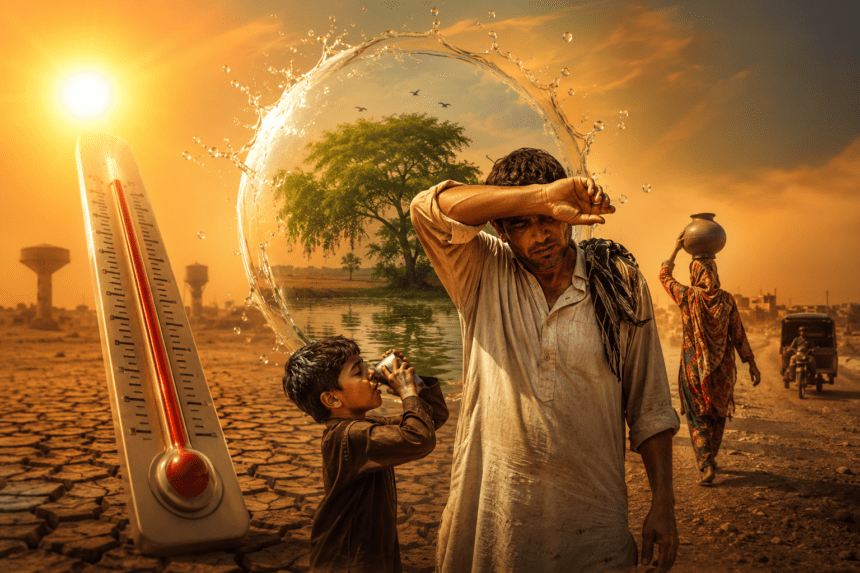
Jacobabad is burning. As mercury levels hit 51 degrees Celsius this week, the city has once again cemented its status as one of the hottest inhabited places on the planet. For the 200,000 people living here, the heat isn’t a seasonal inconvenience; it’s a daily struggle for survival.
The power grid is failing under the strain. Rolling blackouts, often stretching for twelve hours or more, mean that electric fans sit motionless in sweltering homes. For the city’s laborers—the rickshaw drivers, street vendors, and construction workers—the trade-off is brutal: stay home and starve, or work under a sun that can cause heatstroke in minutes.
“You can’t breathe the air, it feels like it’s being pulled out of your lungs,” says Abdul Sattar, a local vendor who spends his afternoons under a makeshift cloth canopy. He keeps a wet towel draped over his head, a common sight on the city’s dusty, shimmering streets. “The shade doesn’t help when the wind itself is like a furnace.”
Medical centers in the district report a steady influx of patients suffering from dehydration and heat exhaustion. Emergency rooms are overwhelmed. Doctors are urging residents to remain indoors between 11 a.m. and 4 p.m., but for those whose daily earnings depend on being outside, that advice is a luxury they cannot afford.
The geography of Jacobabad works against it. Situated in the Sindh province, the city sits in a basin that traps heat, exacerbated by the lack of tree cover and the prevalence of concrete structures that soak up thermal energy during the day. While global climate models repeatedly flag the city as a “wet-bulb” danger zone—where the combination of heat and humidity makes human survival physically impossible—the local reality remains a cycle of adaptation and endurance.
Local authorities have set up a handful of “cooling centers” equipped with misting fans and drinking water, yet these are drops in an ocean. The reach is limited, and for the residents in the city’s sprawling outskirts, the trek to these centers is often too dangerous to attempt in the midday glare.
As the sun sets, the temperature drops, but only slightly. The concrete walls of the houses release the stored heat back into the rooms, turning homes into ovens throughout the night. There is no reprieve.
For the people of Jacobabad, the fight against the elements is not a future climate crisis. It is the reality of their Tuesday, their Wednesday, and the rest of their summer.