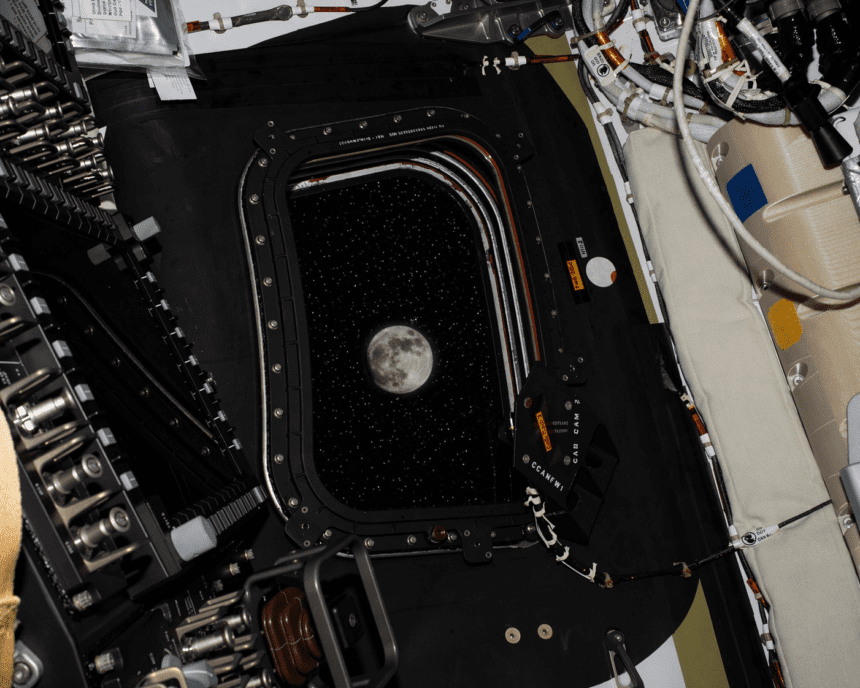
In one of the most emotional moments of NASA’s Artemis II mission, commander Reid Wiseman has spoken about the instant a crater on the Moon was proposed in memory of his late wife, Carroll Taylor Wiseman — a gesture that came just as the crew passed farther from Earth than any humans had gone before. NASA says the crew broke Apollo 13’s long-standing distance record on April 6, 2026, during the mission’s lunar flyby.
The tribute unfolded aboard Orion as the four-member crew looked down at the lunar surface and suggested names for previously unnamed features. NASA’s official mission update said one crater, near the boundary of the Moon’s near and far sides and visible from Earth at times, was proposed as “Carroll” in honor of Wiseman’s wife, who died in 2020. Another crater was suggested as “Integrity,” echoing the crew’s name for their spacecraft.
That timing gave the moment extra weight. Artemis II had just entered the record books, with NASA saying the astronauts reached 248,655 miles from Earth at the moment they surpassed the Apollo 13 mark. By the time the mission ended, the crew had traveled as far as 252,756 miles from home, underlining the scale of a flight that was both technically historic and, at times, deeply personal.
Wiseman’s crewmates — Victor Glover, Christina Koch and Jeremy Hansen of the Canadian Space Agency — were not just marking a milestone in spaceflight. They were also recognizing someone the astronaut corps clearly still feels close to. Reporting on the exchange described the cabin turning emotional as Hansen made the request, with the tribute framed not as ceremony for its own sake, but as something intimate and human in the middle of a mission built around engineering, precision and risk.
There’s a reason the scene has resonated well beyond the space community. Artemis II was always going to be remembered as NASA’s first crewed lunar mission in more than 50 years, the first since Apollo 17 in 1972. But missions like this don’t live on because of numbers alone. People remember the moments that feel real. A crew circling the Moon, finding a bright spot on the surface, and deciding it should carry the name of someone they loved — that lands differently.
The broader mission was historic by any standard. NASA launched Artemis II from Kennedy Space Center on April 1, 2026, sending Wiseman, Glover, Koch and Hansen on a roughly 10-day test flight around the Moon and back. The mission splashed down safely in the Pacific off San Diego on April 10, closing the first crewed lunar flyby of the Artemis era and a crucial test of systems NASA plans to use on future missions.
The crater name itself is still a proposal rather than a formal international designation. Even so, the symbolism is already fixed. In a mission defined by distance, speed and hardware, one of the strongest images to emerge was not the spacecraft or the launch. It was that quiet, raw tribute — a reminder that even at the edge of deep space, astronauts carry their lives with them.