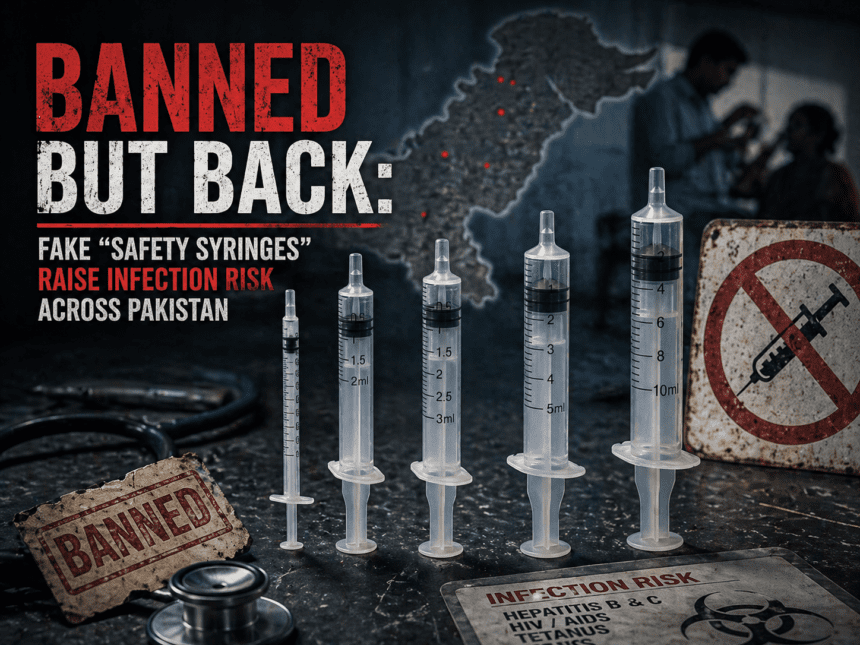
Thousands of counterfeit “safety” syringes are circulating across Pakistan’s major medicine markets, months after a federal crackdown supposedly purged them from the supply chain. These fakes—designed to look like one-time-use Auto-Disable (AD) needles—are being sold to unsuspecting clinics, re-igniting a public health crisis in a country already struggling with some of the world’s highest rates of blood-borne diseases.
This isn’t just a regulatory lapse; it’s a direct threat to life. Real AD syringes are engineered to lock permanently after a single use, making them impossible to recycle.
The counterfeits currently hitting the shelves in Karachi, Lahore, and Peshawar look identical to the naked eye but fail to lock.
They allow for multiple injections, turning a routine medical procedure into a primary driver for the spread of HIV, Hepatitis B, and Hepatitis C. The Drug Regulatory Authority of Pakistan (DRAP) mandated the transition to AD syringes in 2021, banning the manufacture and sale of conventional disposable needles for most clinical uses. But the black market has adapted. Wholesale hubs like Karachi’s Katchi Gali have seen a surge in “lookalike” products.
Some are standard needles repackaged in forged “AD” branding; others are low-grade imports that bypass safety certifications entirely. The price difference is the bait. While a genuine, certified AD syringe costs more due to its complex locking mechanism, the fakes are sold at a fraction of the cost, incentivizing small-town clinics and cash-strapped dispensaries to look the other way.
“The packaging looks professional, even to a trained eye,” said a pharmacist in Lahore who requested anonymity.
“You only realize it’s a fake when the plunger doesn’t click into place after the first shot. By then, the damage is often done.” Health experts warn that the resurgence of these needles could undo years of progress. Pakistan saw a massive HIV outbreak in Larkana in 2019, largely attributed to the reuse of syringes.
Despite that wake-up call, the enforcement of the AD mandate remains porous. While DRAP has issued fresh recall notices and conducted raids in recent weeks, the sheer volume of counterfeit stock suggests a massive failure in border controls and provincial market monitoring.
The “so what” for the average patient is grim. In a healthcare system where patients often buy their own medical supplies, there is currently no easy way for a layperson to verify if the needle they just bought is a life-saving tool or a contaminated hazard.
DRAP has promised “zero tolerance” for distributors caught with the fakes. However, until the regulator can secure the supply chain from the point of entry to the hospital bedside, the ban remains a paper shield against a very real epidemic. The fakes are back, and as long as they are, every injection in a local clinic remains a gamble.