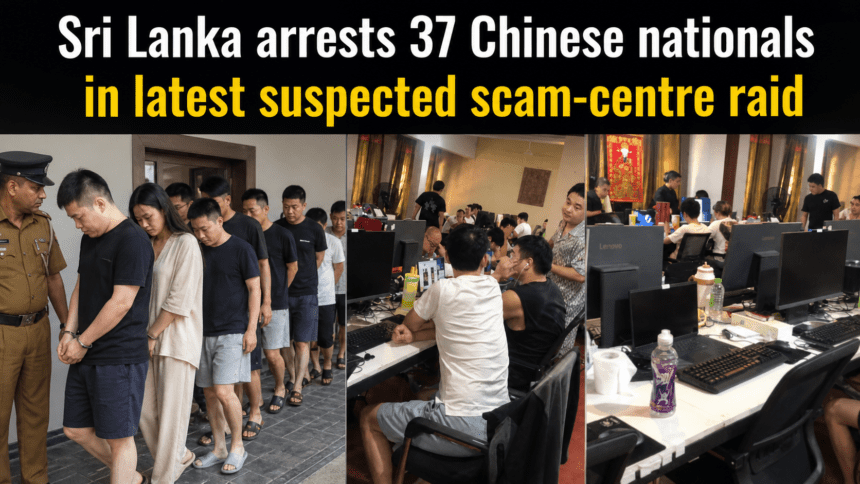
Sri Lankan police have arrested 37 Chinese nationals at a house in Talangama, on the outskirts of Colombo, after investigators said the property was being used as a suspected cyber scam centre. Police spokesman Buddhika Manatunga said officers also seized 35 tablet computers, 147 mobile phones and 100 SIM cards during the operation, which was carried out on Saturday and announced on Sunday.
The raid is the latest sign that Sri Lanka is trying to shut down a growing network of foreign-run online fraud operations that investigators say have quietly spread across the island in recent months. Talangama, usually known more as a residential suburb than a crime hotspot, has now become part of that story. Police have not publicly laid out the full scope of the alleged operation yet, but the volume of devices seized suggests investigators believe the site was being used for organised digital fraud rather than small-scale individual activity.
This did not come out of nowhere. Just a month ago, Sri Lankan police detained 152 foreign nationals, most of them Chinese, in the coastal town of Chilaw after raiding what they described as an alleged hotel-based cyberscam operation. Police spokesman Frederick Wootler said at the time that those directly involved in scamming would face Sri Lankan criminal law, while others could be deported depending on the findings of the investigation.
Before that, on March 17, authorities arrested 134 foreign nationals in a joint operation in Anuradhapura and Mihintale. According to Sri Lankan media reports cited by local officials, that group included 126 Chinese nationals, four people from Myanmar and four from Taiwan. Investigators said they were looking into a suspected online scam network operating from several guest houses, and officers seized laptops, phones and other equipment.
There was another warning sign in mid-April, when customs officials at Sri Lanka’s main international airport arrested nine Chinese nationals accused of trying to bring in communications equipment allegedly meant for scam operations. That case mattered because it suggested the networks were not only active inside Sri Lanka, but may also have had supply lines and planning support moving through ports of entry. The Chinese embassy in Colombo said after that episode that it was working with Sri Lankan authorities to prevent Chinese nationals from carrying out such activities in the country.
Taken together, the arrests point to a broader regional pattern. South and Southeast Asia have been grappling with cyberfraud compounds, call-centre scams and transnational criminal groups that rely on phones, SIM cards, messaging apps and rented properties to run operations across borders. Sri Lanka’s cases appear smaller than some of the massive scam-centre busts seen elsewhere in Asia, but the tempo of the raids has clearly picked up.
For now, the immediate questions are simple: what exactly the Talangama group is accused of doing, who their targets were, and whether the suspects will be prosecuted locally or deported after investigation. Police have not yet released that full picture. But the message from Colombo is getting harder to miss — Sri Lanka no longer wants to be seen as an easy operating ground for foreign cybercrime crews.