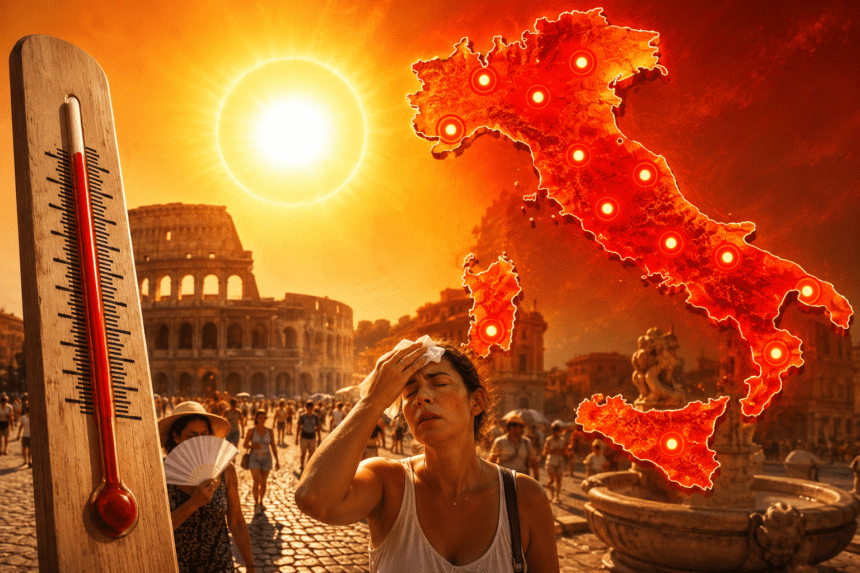
Italy’s health ministry has issued “red alert” warnings across 15 major cities, including Rome, Florence, and Bologna, as a relentless heatwave pushes temperatures toward record-breaking levels. The classification, the highest on the national scale, signals an emergency risk that threatens even healthy individuals.
The government’s decision comes as the “Minos” anticyclone settles over the Mediterranean. In Rome, the Colosseum and the Roman Forum have become heat traps, forcing tourists to seek shade as the mercury climbs toward 43°C (109°F). Local authorities are scrambling to manage the surge in emergency room visits, primarily from elderly residents and outdoor workers struggling with heat exhaustion.
The heat isn’t just a daytime nuisance. Overnight temperatures are refusing to drop below 25°C in many urban centers, depriving millions of the natural cooling cycles needed to recover from the day’s intensity. This “tropical night” effect is keeping the pressure on the national grid, as air conditioning demand hits an all-time peak.
“We are dealing with a climate event that is pushing the limits of urban infrastructure,” said a spokesperson for Italy’s Civil Protection Department. They urged residents to avoid direct sun exposure between 11 a.m. and 6 p.m., a directive that has effectively emptied the streets of major tourist hubs during peak hours.
This surge follows a trend of increasingly volatile summers across Southern Europe. While heatwaves are historically common in the region, the frequency and intensity of these “red alert” events have forced Italian officials to rethink emergency protocols.
Beyond the immediate health risks, the agricultural sector is bracing for impact. Farmers in the Po Valley are already reporting severe water shortages, raising concerns about the long-term viability of crops like rice and corn, which are critical to the local economy.
As the heatwave shows no signs of breaking before the weekend, the government has kept the emergency protocols in place indefinitely. For now, the focus remains on keeping the most vulnerable indoors and the power grid operational, as Italy waits for the high-pressure system to finally shift.