Cambodia is widely recognized as an important example of a country that made major progress in controlling its HIV epidemic.
Its experience demonstrates that reducing HIV transmission is not simply a matter of providing medicines. It requires government leadership, international partnerships, community involvement, prevention programmes, testing and access to treatment.
Cambodia’s progress is particularly notable because the country once had one of the highest HIV prevalence rates in Asia. Over time, coordinated national and community-level efforts helped reverse the epidemic.
Strong Government Leadership
One of the major factors behind Cambodia’s progress was government involvement.
National health authorities worked with international organisations, healthcare providers and community groups to develop HIV prevention and treatment programmes.
This helped move HIV from being treated only as a medical issue to being addressed as a broader public-health and community challenge.
Prevention Became a Major Priority
Cambodia’s HIV response placed strong emphasis on prevention.
Public-health programmes worked with populations at higher risk of HIV transmission and promoted safer sexual practices, testing and awareness.
Earlier programmes also used peer workers and outreach approaches to reach communities that traditional health services could have difficulty accessing. Research on Cambodia’s response has highlighted the importance of government coordination, international support and committed public-health workers.
Communities Played a Critical Role
Community involvement became another important part of the response.
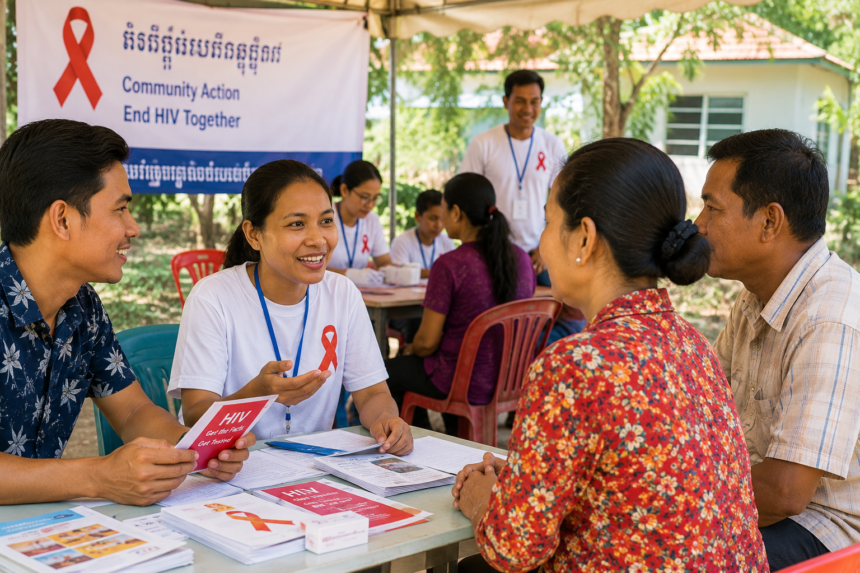
Rather than relying exclusively on hospitals and government offices, programmes worked through local organisations, community workers and people with direct experience of HIV-related challenges.
This approach helped bring information and services closer to people.
Community-based programmes can also reduce fear and stigma because people may be more comfortable discussing sensitive health issues with trusted local workers.
Expanding HIV Testing
Testing is essential because people cannot access appropriate HIV treatment if they do not know their status.
Cambodia’s HIV response therefore expanded testing and outreach services.
Healthcare organisations have continued working with Cambodia’s Ministry of Health and the National Centre for HIV/AIDS, Dermatology and STIs to provide HIV testing and treatment. AHF Cambodia currently reports support for HIV treatment sites across multiple provinces and community-based testing initiatives.
Access to Treatment Changed the HIV Response
The expansion of antiretroviral therapy also transformed HIV care.
Modern HIV treatment can suppress the virus to very low levels, allowing people living with HIV to live much longer and healthier lives.
Treatment also has an important prevention benefit because people who maintain an undetectable viral load do not sexually transmit HIV.
Cambodia’s progress therefore involved both preventing new infections and improving the lives of people already living with HIV.
International Partnerships
Cambodia’s experience also shows the importance of partnerships.
Government agencies have worked alongside international organisations, NGOs, healthcare providers and community networks.
Such partnerships can provide funding, technical expertise, training, medicines and services that strengthen national health programmes.
AHF Cambodia, for example, describes collaboration with Cambodia’s Ministry of Health, NCHADS, provincial health departments, hospitals and local organisations.
Reaching Vulnerable Communities
One of the lessons from Cambodia’s experience is that national HIV programmes must reach people who may otherwise remain outside conventional healthcare systems.
Outreach workers and community programmes can help connect people with testing, counselling, prevention information and treatment.
Earlier community programmes in Cambodia demonstrated how local workers, former drug users, families and health professionals could work together to reach vulnerable populations.
The Role of Stigma
HIV-related stigma can prevent people from getting tested or seeking treatment.
When people fear discrimination, they may avoid healthcare services even when those services are available.
Community engagement can help challenge misconceptions and create more supportive environments for people living with HIV.