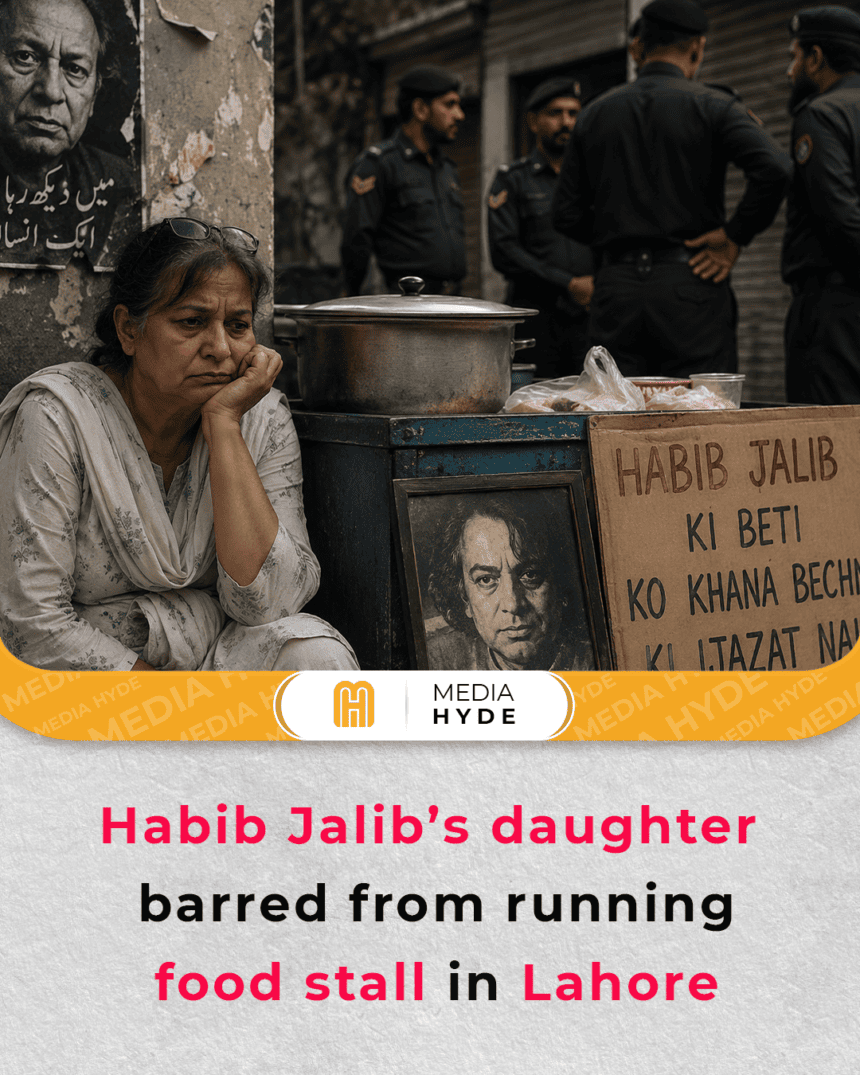
Tahira Habib Jalib, daughter of the legendary revolutionary poet Habib Jalib, has been forced to shutter her small food stall in Lahore after facing persistent obstruction from local authorities.
The stall, a modest setup intended to provide a livelihood, became the center of a bureaucratic standoff when officials from the local administration arrived to dismantle her operation. Despite her father’s legacy—a man whose verses defined resistance against state oppression for decades—Tahira found herself navigating the same systemic indifference he once spent his life fighting.
The irony is not lost on those familiar with Jalib’s work. The poet, who spent years in prison for his defiance, famously wrote about the struggles of the common person. Today, his daughter is battling for the basic right to self-employment, highlighting a widening gap between the state’s reverence for his poetry and its treatment of his family.
“They talk about his poetry in seminars,” Tahira said, reflecting on the incident. “But when it comes to the dignity of his children, the doors are closed.”
Local administration officials cited “encroachment” regulations as the primary reason for the removal. They argue that the stall obstructed public pathways, a standard justification used in sweeping anti-encroachment drives across Lahore. However, supporters and civil society members argue that the state’s rigid application of these rules often ignores the survival needs of vulnerable citizens, especially when the individual involved carries a name that represents the very conscience of the nation.
The situation has sparked a wave of indignation on social media, where users are pointing to the state’s failure to support a family whose contribution to Pakistan’s cultural and political identity is undisputed. For many, this isn’t just about a food stall; it is a symbol of how the country treats those who hold a mirror to its failures.
As the stall remains closed, the administration has yet to offer an alternative or a pathway for Tahira to operate legally. For now, the daughter of the man who gave voice to the voiceless is finding that her own voice is being muffled by the same bureaucracy her father spent a lifetime challenging.