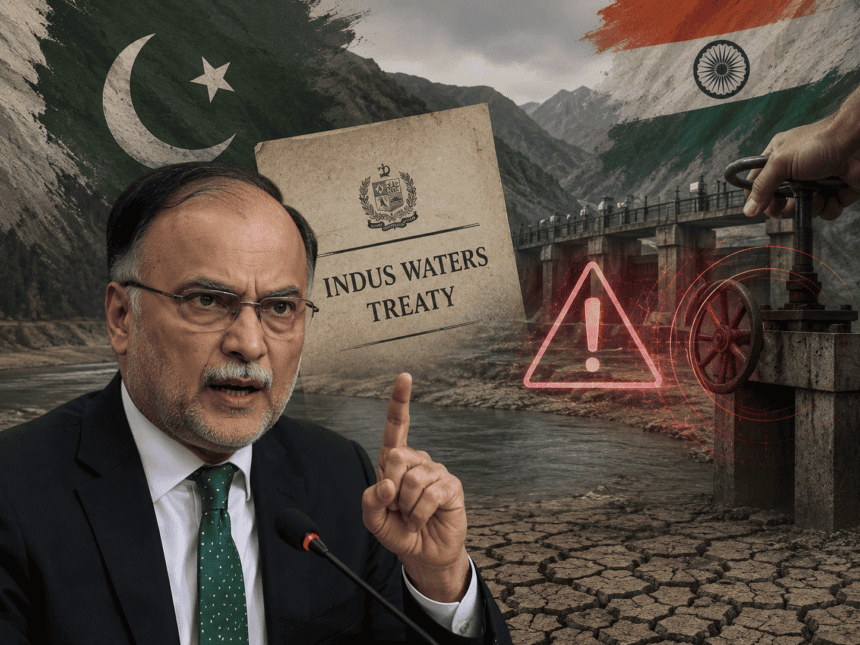
Planning Minister Ahsan Iqbal has issued a sharp warning regarding the Indus Waters Treaty, claiming India is increasingly using water as a strategic tool to pressure Pakistan. His comments arrive amid long-standing tensions over upstream dam projects and shifting hydrological realities in the region.
“Water has become a weapon,” Iqbal said during a recent briefing. He argued that the spirit of the 1960 treaty is being undermined by India’s accelerated construction on the Chenab and Jhelum rivers, maneuvers he views as a direct threat to Pakistan’s agricultural lifeline.
The minister’s frustration centers on the Kishanganga and Ratle hydroelectric projects. While India maintains these projects are “run-of-the-river” schemes permitted under the treaty, Islamabad views them as clear violations that allow New Delhi to manipulate flow rates during critical planting seasons.
The treaty—brokered by the World Bank—has survived three wars and decades of diplomatic frost. Yet, the current standoff is different. For the first time in years, both nations are exploring the limits of the agreement’s dispute resolution mechanisms. Pakistan has pushed for an international court of arbitration, while India insists on appointing a neutral expert to resolve technical disagreements.
This procedural deadlock has paralyzed progress.
“We are not just talking about technical specifications anymore,” an official familiar with the Ministry of Water Resources told reporters. “We are talking about the survival of the Indus Basin.”
The consequences are tangible. Pakistan’s agricultural sector, which accounts for nearly 20% of its GDP, remains hyper-sensitive to any reduction in water availability. Even minor fluctuations in flow, whether caused by climate change or upstream interventions, ripple through the economy, affecting everything from wheat yields to electricity generation at the Tarbela and Mangla dams.
While the World Bank has attempted to nudge both sides toward a consensus, the diplomatic path forward remains obscured by broader geopolitical hostility. Neither side appears willing to blink, leaving the treaty—once hailed as a model of international cooperation—strained under the weight of modern national security imperatives.
As the next monsoon season approaches, the focus is shifting from legal arbitration to the physical reality on the ground. For farmers in Punjab and Sindh, the debate over treaty clauses is secondary to the simple, urgent question of whether the rivers will bring enough water to sustain their crops.