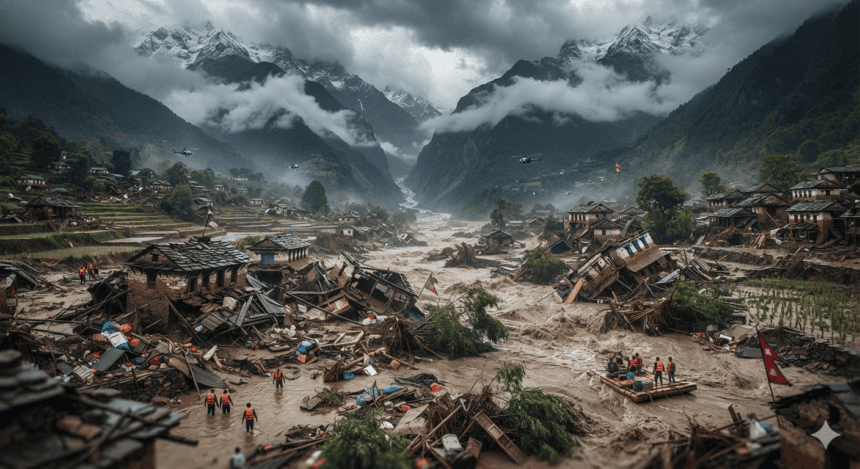
The search for survivors continues across Nepal after catastrophic flooding and landslides claimed at least 95 lives, with hundreds more reported missing. Monsoon-triggered deluges swept through entire villages, leaving critical infrastructure shattered and rescue teams struggling to reach isolated communities in the Himalayan foothills.
The destruction is concentrated in the Kathmandu Valley and surrounding districts, where the Bagmati and other major rivers breached their banks over the weekend. Homes were flattened in minutes, trapping families under mud and debris. In many areas, the sheer force of the water washed away bridges and severed main highway links, effectively cutting off entire districts from emergency aid.
“We have lost everything,” said a resident from a submerged neighborhood in Lalitpur, one of the hardest-hit areas. “The water rose so fast we didn’t even have time to move our livestock, let alone our belongings.”
Disaster management officials are facing a logistical nightmare. While the Nepal Army and police have deployed helicopters to airlift those stranded on rooftops, dense cloud cover and persistent rain have grounded search aircraft for hours at a time. The death toll is expected to rise as rescue crews finally gain access to remote mountain hamlets that have been completely cut off since Friday.
Beyond the immediate loss of life, the economic toll is mounting. The floods have decimated thousands of hectares of standing crops just weeks before the harvest season. For an economy heavily reliant on subsistence agriculture, the loss of these fields spells a looming food security crisis for the coming winter.
Government officials confirmed that power grids across the capital and neighboring regions remain unstable. While electricity is slowly being restored in parts of Kathmandu, many rural areas face weeks without power or clean water, raising the specter of waterborne disease outbreaks.
Prime Minister K.P. Sharma Oli has urged citizens to remain vigilant, promising that the government will prioritize relief distribution. However, local activists argue that the state’s emergency response remains reactive. They point to years of unregulated construction along riverbanks and poor urban planning as the primary reasons why seasonal monsoon rains have turned into such frequent, high-casualty events.
As the rain finally begins to taper off, the focus shifts from rescue to recovery. For the families digging through the silt and wreckage in search of loved ones, the government’s promises of aid offer little comfort against the scale of the devastation.