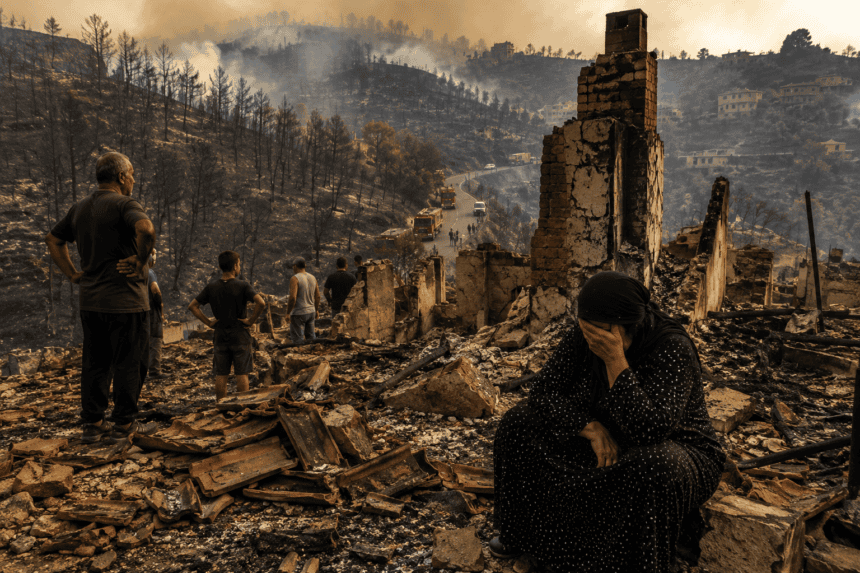
The fires didn’t just burn the forests; they erased entire neighborhoods in northern Algeria. As search crews continue to navigate the smoldering remains of homes in the Bejaia and Bouira regions, officials expect the current death toll of 34 to climb significantly.
For those who escaped, the reality of the aftermath is setting in. “There is nothing left,” said Ahmed, a resident of a small village near the coast who fled with only the clothes on his back. “The wind carried the fire faster than we could run. My house, my orchard, my history—gone in an hour.”
The intensity of the blazes, fueled by a relentless heatwave pushing temperatures toward 48°C (118°F), overwhelmed local firefighting capabilities. While the government deployed over 8,000 personnel and dozens of aircraft to combat the flames, the sheer scale of the inferno forced thousands to evacuate. Many residents reported a lack of warning, pointing to a breakdown in communication as the fires jumped from mountain ridges into residential valleys.
Meteorologists attribute the severity of this year’s fire season to a combination of prolonged drought and the extreme heat dome settling over the Mediterranean basin. While North Africa is accustomed to summer brushfires, the speed and ferocity of this week’s events have pushed emergency services to their breaking point.
Critics of the government’s response argue that the country’s fleet of specialized firefighting planes—some of which have been under maintenance—was insufficient to handle a catastrophe of this magnitude. Interior Ministry officials have countered that the unpredictable, gale-force winds made aerial intervention impossible for long stretches of Tuesday and Wednesday.
As the smoke begins to clear, the focus shifts from containment to recovery. Families are returning to find metal skeletons of cars and ash-covered foundations where their lives once stood. For the thousands currently sheltering in makeshift camps and local schools, the immediate concern isn’t just the loss of property, but the uncertainty of how to rebuild in a region where the climate is becoming increasingly hostile.
With authorities confirming that several fires are still active, the government has vowed to investigate the causes of the outbreaks, including potential cases of arson. But for the survivors picking through the debris, the cause matters less than the immediate, crushing silence left in the fire’s wake.