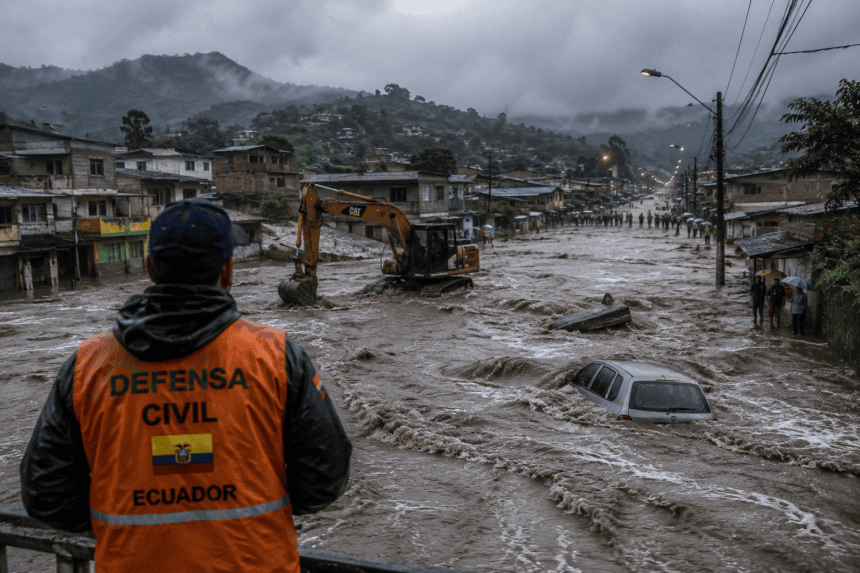
QUITO — The Ecuadorian government has triggered a nationwide state of emergency, bracing for the severe weather patterns brought on by El Niño. President Daniel Noboa signed the decree late Tuesday, citing the immediate threat to public safety and critical infrastructure posed by impending torrential rains and potential flooding.
The emergency designation allows the government to bypass standard bureaucratic hurdles for procurement, effectively fast-tracking the deployment of machinery and emergency funds. Officials are particularly worried about the coastal regions, where soil saturation from previous months has already destabilized hillsides and compromised road networks.
“We aren’t waiting for the catastrophe to peak,” a government spokesperson said on Wednesday. The administration is prioritizing the clearance of drainage systems and the reinforcement of river dikes that failed during the last major climate event in 1998.
The stakes are high for Ecuador’s economy. The agriculture sector, a pillar of the nation’s exports, sits directly in the path of the projected heavy rainfall. Farmers in the Guayas basin are already reporting concerns over crop yields, as excess water threatens to drown banana plantations and rice paddies—the country’s primary agricultural commodities.
Meteorologists at the National Institute of Meteorology and Hydrology (INAMHI) warn that this iteration of El Niño is not a localized event. It is a systemic shift in Pacific temperatures that promises consistent, heavy precipitation throughout the first quarter of the year. While the government has moved to secure emergency budgets, the challenge remains in coordinating a response across rural provinces where communication lines are often the first to fail during severe storms.
Critics of the administration, however, are questioning the timing. Some opposition leaders argue the emergency decree is a tool to consolidate executive power during a period of ongoing internal security crises, rather than a purely climate-driven necessity.
Despite the political noise, the reality on the ground is stark. Emergency management teams have begun evacuating families from low-lying areas near the Chone River. For those residents, the government’s bureaucratic maneuvers matter less than the height of the water line.
With the rainy season now in full swing, the next six weeks will serve as a definitive test of the country’s aging infrastructure. If the climate models hold, Ecuador’s ability to keep its trade routes open will depend entirely on how quickly these emergency funds translate into actual boots on the ground.