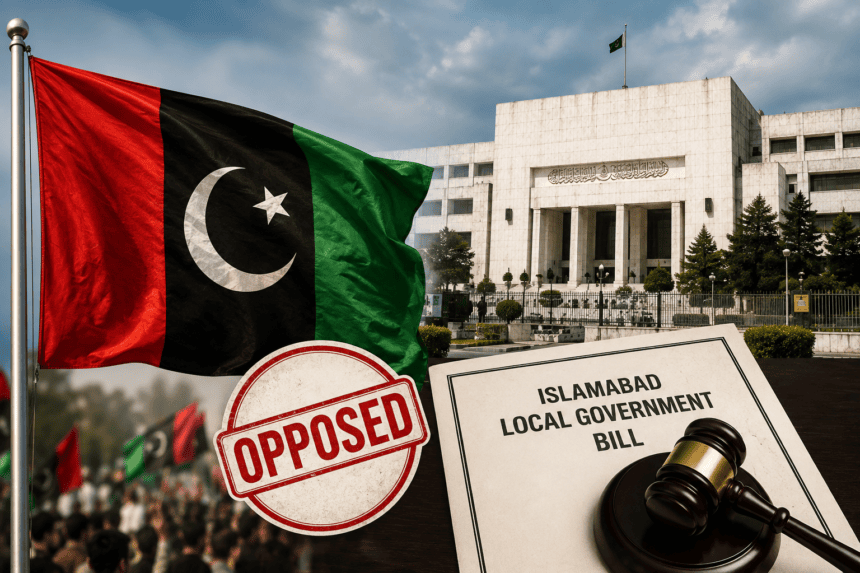
The Pakistan People’s Party (PPP) has formally decided to oppose the proposed Islamabad local government bill, effectively breaking ranks with its coalition partners. Party insiders confirmed the decision late Tuesday, citing concerns over the central government’s attempt to centralize municipal powers in the capital.
The move marks a sharp turn in the PPP’s relationship with the federal government. While the two parties have largely maintained a unified front on national policy, the governance of Islamabad has become a point of friction. PPP leadership argued that the bill, in its current form, strips elected representatives of the autonomy required to manage the city’s civic infrastructure.
“We cannot support legislation that weakens the grassroots level,” a senior PPP leader told reporters on condition of anonymity. “The party’s stance is clear: local governments must be empowered, not turned into administrative wings of the federal bureaucracy.”
The disagreement centers on the administrative control of the Capital Development Authority (CDA). The bill, championed by federal ministers, seeks to retain significant regulatory and financial oversight within the federal cabinet, a move the PPP believes undermines the spirit of the 18th Amendment.
For the federal government, the bill was intended to streamline services in Islamabad, where residents have long complained about disjointed waste management and water supply issues. By keeping the CDA under federal control, proponents argued they could bypass the bureaucratic gridlock that often plagues local municipal bodies.
The PPP’s opposition complicates the bill’s path in the National Assembly. Without the support of their primary coalition ally, government managers face a difficult floor vote. They will now have to either negotiate significant concessions to win back PPP support or seek backing from opposition benches—a move that carries its own political risks.
If the bill fails to clear the house, the federal government will be forced to return to the drawing board, leaving Islamabad’s municipal governance in its current state of legal limbo. For the residents of the capital, the political standoff means that promised reforms to city services are effectively on hold.
The party’s formal dissent is expected to be tabled in the upcoming parliamentary session, where the debate over the capital’s future is set to test the endurance of the current ruling coalition.