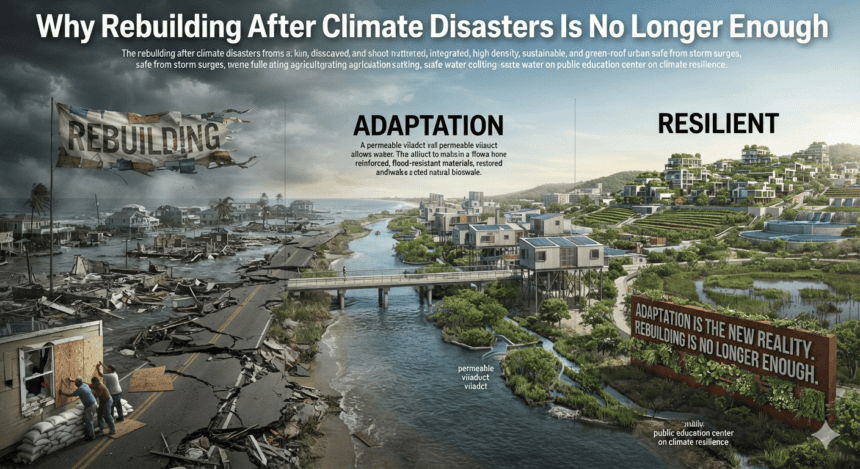
The old playbook is broken. For decades, governments responded to climate disasters by repairing roads, patching bridges, and rebuilding homes exactly where they stood. That era is over. As extreme weather events grow more frequent and intense, the cycle of “recover and repeat” is no longer just ineffective—it’s a financial and humanitarian liability.
Engineers and urban planners are now shifting the conversation from recovery to retreat. The core problem is simple: we are rebuilding assets in high-risk zones that are now fundamentally incompatible with a warming planet.
“We’re essentially subsidizing the next disaster,” says Dr. Aris Thorne, a senior researcher at the Institute for Climate Resilience. “When you rebuild a house in a floodway using taxpayer money, you aren’t solving a problem. You’re just hitting the snooze button on the inevitable.”
The data backs this up. Federal disaster relief spending has ballooned over the last decade, yet the economic losses from climate-linked events continue to climb. In coastal regions, repeat-loss properties—homes that have flooded and been rebuilt multiple times—account for a disproportionate share of insurance payouts. This isn’t just a fiscal drain; it’s a policy failure that keeps families trapped in dangerous terrain.
The alternative—managed retreat—remains politically toxic. Moving entire communities away from coastlines or wildfire-prone valleys requires moving schools, hospitals, and livelihoods. It disrupts the social fabric, and local politicians rarely survive the backlash of telling constituents their ancestral homes are no longer viable.
Still, the economics are forcing a rethink. Insurance companies are quietly exiting high-risk markets, leaving homeowners without coverage. When the private market stops betting on the safety of a location, the government is left as the insurer of last resort. This creates a massive, hidden liability on public balance sheets.
Instead of pouring concrete into the same vulnerable spots, some municipalities are experimenting with “nature-based buffers.” This means turning former residential zones into wetlands or parklands that absorb floodwater rather than resisting it. It’s a shift from hard infrastructure to flexible land use.
The reality is uncomfortable. We are reaching a point where the cost of protection exceeds the value of the assets being protected. If the goal is long-term survival, the focus must shift away from the architecture of recovery and toward the difficult, expensive, and necessary work of moving out of harm’s way.
“We can spend billions trying to hold back the tide,” Thorne says. “Or we can admit that the map has changed.”