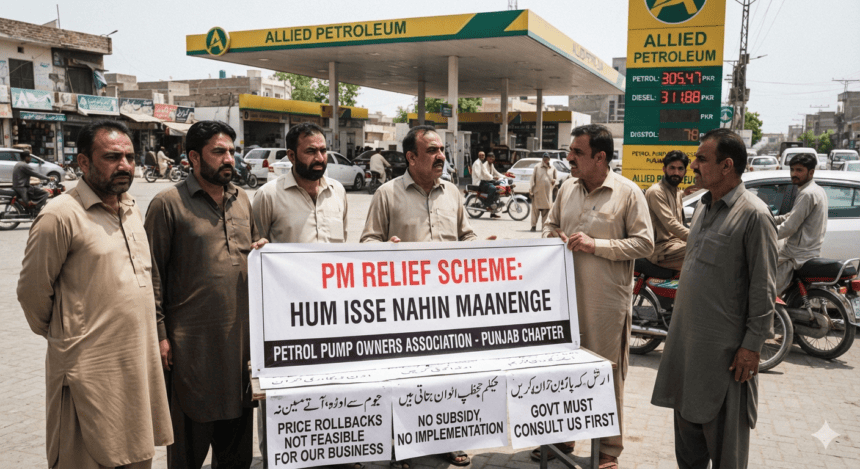
Pakistan’s retail fuel sector has hit a stalemate with the federal government. The Pakistan Petroleum Dealers Association (PPDA) officially rejected the Prime Minister’s latest relief scheme on Monday, arguing the proposal threatens the survival of thousands of small-scale fuel stations.
The government’s plan aimed to lower retail prices through a restructuring of dealer margins, a move officials framed as direct relief for inflation-weary motorists. Dealers, however, see it differently. They argue that the current margins are already razor-thin, squeezed by rising electricity costs and soaring operational overheads.
“We aren’t in the business of charity,” said Abdul Sami Khan, chairman of the PPDA, during an emergency meeting in Karachi. “The government wants to pass the burden of price cuts onto us. We can’t pay our staff or keep the lights on if our margins are slashed further.”
The disagreement centers on the dealer margin percentage. While the Petroleum Division maintains that the adjustment is necessary to stabilize consumer prices, dealers point to the devaluation of the rupee and high interest rates as the real culprits behind the cost crisis.
For the average commuter, the standoff creates immediate uncertainty. If the PPDA moves forward with its threatened strike, thousands of stations nationwide could go dry within 48 hours. The association has already directed its members to stop purchasing new fuel stocks from oil marketing companies as a tactical warning.
Government officials have downplayed the threat, labeling the move as an attempt to blackmail the state. A senior official at the Petroleum Division told reporters that the government remains open to negotiations but will not allow “private cartels to dictate national energy policy.”
Behind the rhetoric lies a deeper structural issue: the state’s reliance on fuel levies to bridge its fiscal deficit. As the government struggles to meet International Monetary Fund (IMF) revenue targets, it has little room to subsidize prices. Meanwhile, the dealers argue they are being scapegoated for a systemic failure they didn’t create.
Talks between the Petroleum Division and the PPDA are expected to resume Wednesday. Until then, the fuel supply chain remains fragile, and the prospect of long queues at pumps hangs over major urban centers.