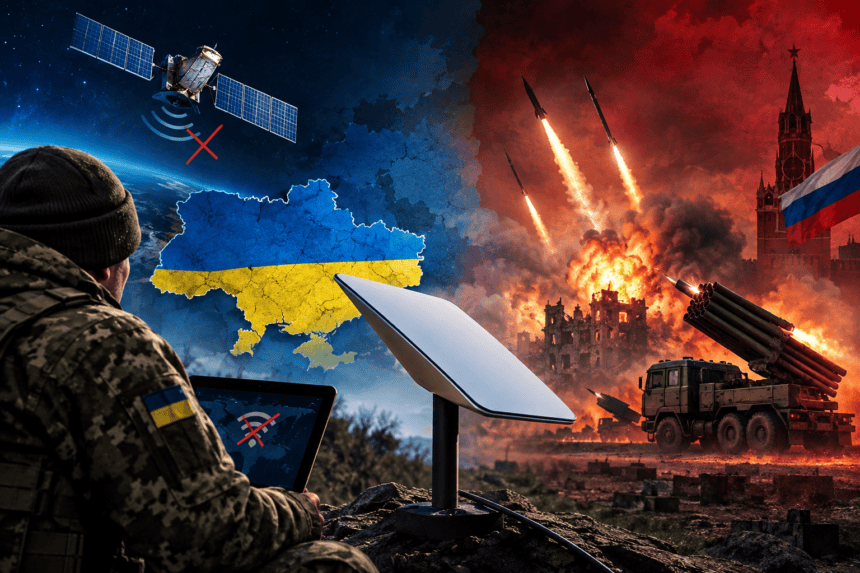
KYIV — Ukraine’s reliance on Elon Musk’s Starlink network has hit a critical friction point. As Russian forces intensify their tactical offensive across the eastern front, Ukrainian commanders report increasingly erratic satellite connectivity, forcing units to operate in near-total digital darkness during high-stakes maneuvers.
The outages aren’t just technical glitches. They represent a shifting geopolitical reality where the Ukrainian military’s most vital communication tool is now subject to the whims of its private provider. Frontline commanders say the restricted access—often triggered when units cross into contested or newly occupied territory—has directly hampered their ability to coordinate drone strikes and artillery fire.
For a military that built its modern doctrine around real-time intelligence and rapid data sharing, these dead zones are lethal.
“We lose the feed, we lose the target,” a drone operator near Pokrovsk said. “When the satellite drops out, we are flying blind into a wall of Russian electronic warfare.”
The Pentagon has spent months attempting to negotiate a more permanent, unrestrictive contract with SpaceX to ensure service remains uninterrupted. While the U.S. government has secured some dedicated capacity, the reality on the ground remains fractured. Musk’s personal involvement in the conflict’s digital infrastructure—and his stated desire to avoid direct escalation—has created a shadow policy that often runs contrary to official U.S. support.
Russia, meanwhile, has doubled down on its own electronic warfare capabilities. By pairing jamming technology with the inherent limitations of Starlink’s geofencing, Moscow has effectively turned Ukraine’s technological advantage against it. The Kremlin’s goal is simple: force Ukrainian forces into legacy communication methods that are easily intercepted, triangulated, and destroyed by long-range artillery.
Military analysts point to a dangerous dependency. Ukraine cannot win a war of attrition against a larger, better-equipped Russian force without the high-speed data links Starlink provides. Yet, the current arrangement leaves Kyiv vulnerable to the unpredictable decision-making of a private billionaire who has repeatedly signaled his skepticism regarding the conflict’s long-term trajectory.
The White House has remained tight-lipped on the specifics of its ongoing talks with SpaceX. Officials insist that “service continuity” is a priority, but the tactical reality for soldiers in the trenches suggests otherwise.
As the frontlines shift and Russian pressure mounts, the question is no longer just about hardware. It is about whether a private corporation can—or should—hold the kill switch on a sovereign nation’s defense. For now, the soldiers on the ground are the ones paying the price for that ambiguity.