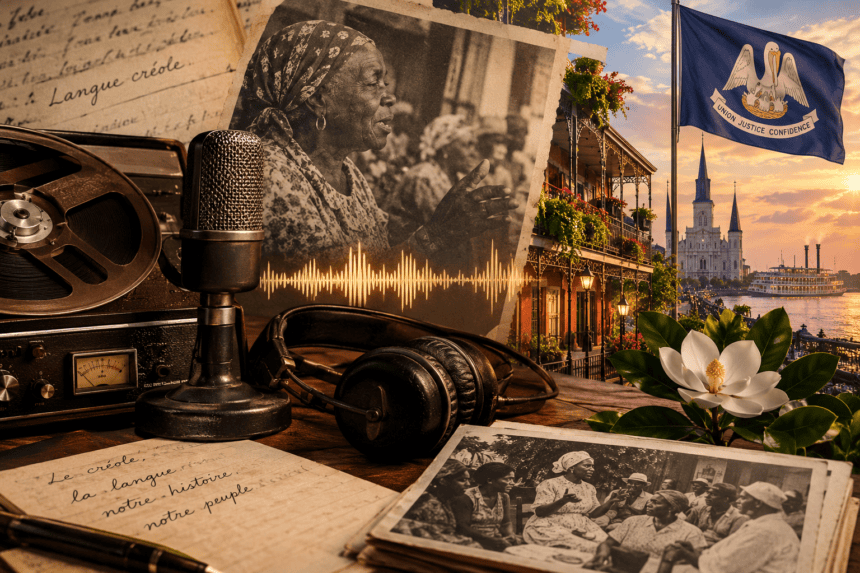
A scratchy, decades-old acetate disc has become a digital lifeline for a language on the brink of extinction. Researchers have finally published the oldest known audio recordings of Louisiana Creole, capturing the cadence and vocabulary of a community that has seen its mother tongue steadily fade from public life.
The audio, unearthed from the archives of the Library of Congress, features elderly speakers from the 1930s. These voices, long silenced by time, offer a rare, unfiltered look at the linguistic bridge between French, African, and Caribbean influences that defined the state’s cultural landscape two centuries ago.
For years, linguists labeled Louisiana Creole a “dying” language. As English became the dominant medium for education and commerce, the intergenerational chain of transmission snapped. Today, only a small fraction of the population remains fluent. These recordings provide more than just a historical artifact; they serve as a primary source for scholars attempting to document the language’s evolution before it disappears entirely.
The collection includes folk tales, personal anecdotes, and traditional songs. Unlike modern attempts to revive the language through textbooks, these tracks reveal the natural rhythm, intonation, and regional variations that formal schooling often misses.
“The nuance is what matters,” said one researcher involved in the digitization project. “You can write down the grammar, but you can’t write down the soul of the speech. Hearing how they transition between French roots and African-influenced syntax gives us a window into a culture that was rapidly changing even then.”
The project arrives at a critical moment. Younger generations in Louisiana are showing renewed interest in their heritage, yet they face a dearth of authentic learning materials. By making these recordings publicly available, archivists hope to provide a blueprint for preservationists.
The struggle to save the language is about more than vocabulary. It is a battle against the erasure of a specific identity. As the last generation of native speakers passes on, these recordings remain the only bridge left to a past that was nearly lost to the silence of the archives.
For now, the files sit open on the digital shelf—not as a museum piece, but as a living record for anyone determined to keep the pulse of Louisiana Creole beating just a little longer.