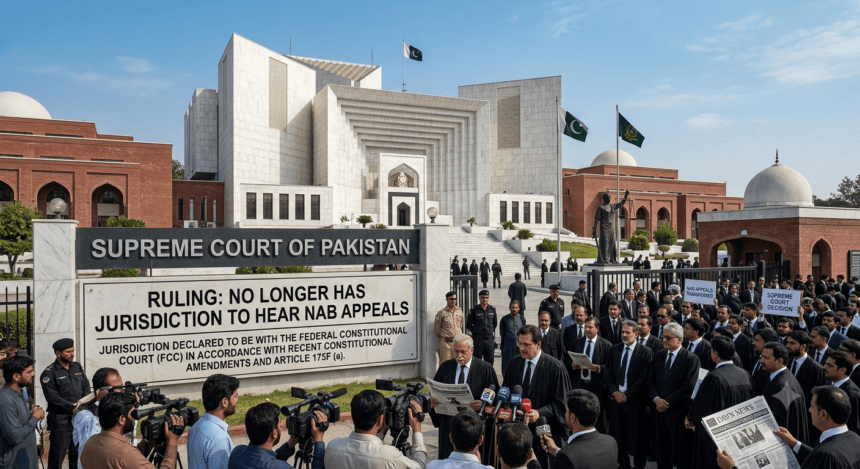
The Supreme Court of Pakistan has officially curtailed its own authority, ruling that it no longer holds the jurisdiction to hear appeals against decisions made by the National Accountability Bureau (NAB) courts. This decision marks a definitive shift in the legal landscape surrounding high-profile corruption cases, effectively moving the final word on these matters back to the high courts.
The bench, led by Justice Aminuddin Khan, reached the consensus after reviewing the legal framework governing the accountability process. By declining to intervene in NAB-related appeals, the apex court is signaling a return to procedural hierarchy. It’s a move that limits the Supreme Court’s role to constitutional interpretation rather than acting as a court of first appeal for corruption proceedings.
This change carries immediate consequences for dozens of pending cases. Defense lawyers have long argued that the Supreme Court’s oversight created a bottleneck, often leading to protracted litigation that outlasted the careers of the defendants themselves. With this ruling, the burden of finality now rests squarely on the provincial high courts.
Legal analysts see this as a necessary step to reduce the court’s mounting backlog. For years, the apex court has been inundated with interlocutory appeals—legal challenges filed during the middle of a trial—which frequently brought NAB proceedings to a grinding halt. By closing this door, the court is forcing a shift in strategy. Litigants can no longer bypass lower benches in hopes of a swift intervention from the top.
The decision arrives amidst a broader debate regarding judicial overreach. Critics of the previous system frequently pointed out that the Supreme Court’s willingness to entertain NAB appeals effectively turned the country’s highest bench into a trial court. This ruling, however, strips away that layer of scrutiny, leaving the accountability process to function within the traditional trial-and-appeal structure.
Whether this will accelerate the disposal of corruption cases remains the central question. While it removes the Supreme Court as a final destination for litigation, it places immense pressure on the high courts to manage complex financial cases without the safety net of an immediate appeal to the top.
For the National Accountability Bureau, the ruling is a double-edged sword. It simplifies the litigation path, but it also means the Bureau’s prosecution teams must be prepared to win their arguments in the high courts—and accept those rulings as final. The era of the Supreme Court acting as the ultimate arbiter in every corruption dispute has effectively ended.