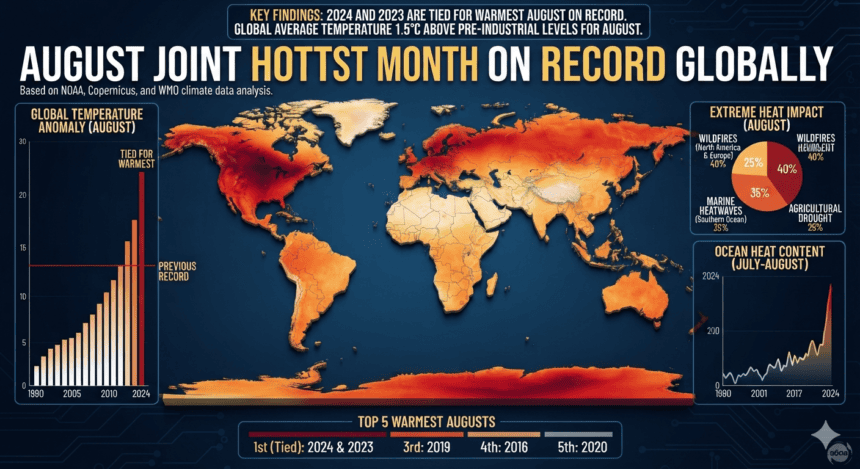
August was the joint-hottest month ever documented, according to data from the European Union’s Copernicus Climate Change Service. Global temperatures mirrored the record-breaking heat of August 2023, confirming a relentless trend of warming that shows no signs of slowing.
Average surface air temperatures reached 16.82°C last month, nearly identical to the levels recorded exactly one year ago. The margin between the two years is so slight—less than 0.01°C—that scientists classify them as a statistical tie. This marks the 13th month in a 14-month streak where global temperatures have exceeded the 1.5°C threshold above pre-industrial levels.
The heat isn’t just a series of data points; it’s a tangible crisis. Extreme weather events, from relentless heatwaves in the Mediterranean to catastrophic flooding in parts of Asia, have become more frequent and more intense. These events are the direct, observable consequences of a planet trapping more heat than it can release.
“The temperature anomaly for August 2024 was 1.51°C above the 1850-1900 pre-industrial level,” said Samantha Burgess, deputy director of the Copernicus service. For Burgess, the numbers aren’t just figures on a screen—they are a warning. She noted that unless the world makes drastic, immediate cuts to greenhouse gas emissions, this “record-breaking” cycle will simply become the new baseline.
The data underscores a grim reality for the remainder of the year. With the Arctic sea ice melting at accelerated rates and ocean surface temperatures remaining at record highs, 2024 is now on track to potentially unseat 2023 as the hottest calendar year in history.
For many regions, the damage is already locked in. Infrastructure in cities designed for cooler climates is buckling under the pressure of prolonged heat, while agricultural yields in several breadbasket regions are showing signs of strain.
The question for policymakers is no longer whether the planet is warming, but how quickly they can adapt to a climate that is becoming increasingly volatile. As the heat persists, the window to prevent even more severe disruptions is closing.