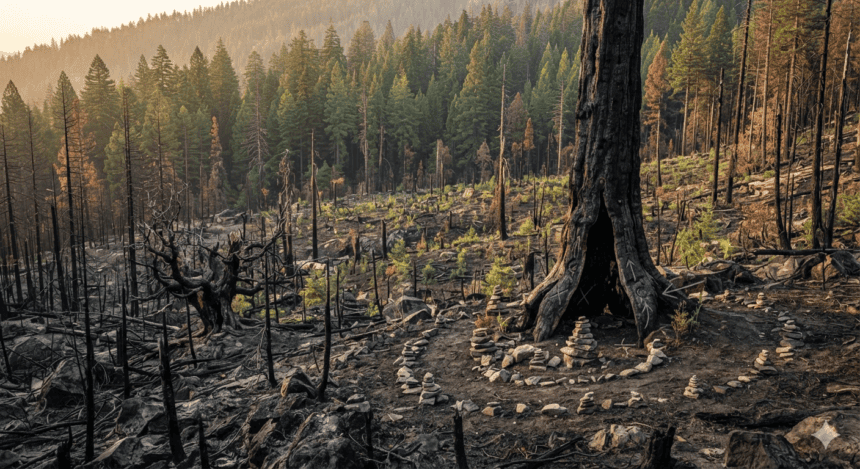
Forests incinerated by high-intensity wildfires may never return to their original state. Research confirms that when fires burn with enough heat to strip away soil nutrients and destroy deep-seated seed banks, the landscape enters a state of permanent ecological transition.
“We aren’t just looking at a few decades of regrowth,” said Dr. Elena Vance, a wildfire ecologist who tracks post-burn forest succession. “Once you cross the threshold of soil sterilization, you lose the biological memory of that ecosystem. You’re looking at a two-to-three-hundred-year recovery window—if the climate allows for it at all.”
The problem lies in the intensity of modern fires. Past forest management focused on suppression, which allowed underbrush to accumulate. Now, when these areas ignite, the resulting heat is sufficient to bake the earth, turning soil hydrophobic. Water no longer penetrates the ground; it runs off, taking the remaining topsoil and essential microbes with it.
Without these microbes, native tree species struggle to take root. Instead, fast-growing, opportunistic weeds and invasive shrubs often dominate the landscape. These plants create a new fire cycle, fueling smaller, more frequent blazes that prevent the original forest canopy from ever reclaiming the site.
The shift is hitting the American West and parts of the Mediterranean particularly hard. In regions that were once dense, carbon-sequestering coniferous forests, researchers are now mapping vast stretches of “scrubland” where trees have failed to regenerate for two consecutive decades.
The economic and environmental cost is compounding. Forests act as natural water filters and carbon sinks. When they transition into scrubland, the land loses its ability to regulate local temperatures and manage water tables. Municipalities downstream are already seeing increased sedimentation in reservoirs—a direct consequence of the denuded slopes above.
“The assumption has always been that forests are resilient,” said forest hydrologist Marcus Thorne. “But resilience has a limit. We’ve pushed these systems past their breaking point, and we’re now watching them reset into something far less productive.”
The window for intervention is narrow. Forest services are experimenting with active replanting and soil inoculation, but these efforts are expensive and labor-intensive. They cover only a fraction of the millions of acres lost annually.
For the vast majority of these scorched landscapes, the clock hasn’t just stopped; it has reset. The forests that defined these regions for centuries are effectively gone, replaced by a hotter, drier, and more volatile version of the land.