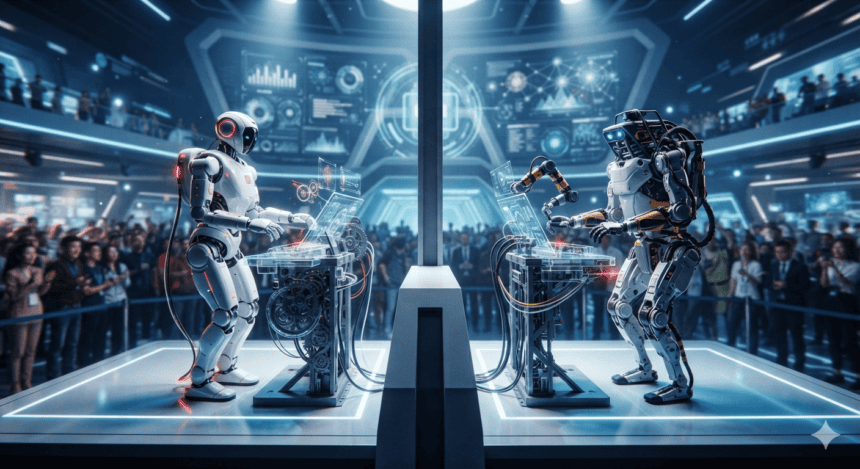
Beijing and Washington are no longer just competing over semiconductors and AI software. The new front line is physical: humanoid robots designed to replace human labor on factory floors and in nursing homes.
While the US holds the lead in generative AI, China is moving with aggressive, state-backed speed to dominate the hardware manufacturing of these machines. Beijing’s Ministry of Industry and Information Technology recently set a concrete target: mass production of humanoid robots by 2025. It isn’t just a goal; it’s a mandate backed by local government subsidies and a massive supply chain advantage.
Tesla, meanwhile, remains the American standard-bearer with its Optimus project. Elon Musk has staked the company’s long-term valuation on the robot’s ability to perform tasks in Tesla’s own automotive plants. The strategy is clear: refine the bot in-house before scaling to the global market.
But scale remains the primary hurdle for the West. Chinese startups, such as Fourier Intelligence and Unitree Robotics, are already shipping units to international labs and research facilities at a fraction of the cost of their American counterparts. They are leveraging China’s mature electronics and battery manufacturing base to iterate designs faster than US firms can prototype them.
The stakes go beyond manufacturing efficiency. Humanoid robots represent the ultimate test of “embodied AI.” Whoever wins this race controls the technology that bridges the gap between digital intelligence and physical reality.
“We are seeing a shift from robots that follow static paths to machines that can navigate unpredictable human environments,” said robotics analyst Sarah Chen. “The country that solves the dexterity and battery life challenges first effectively writes the manual for the next industrial revolution.”
Washington has responded with a familiar playbook: export controls. The US is increasingly tightening restrictions on the high-end sensors and specialized actuators essential for these robots, hoping to throttle China’s progress.
Beijing has countered by accelerating its domestic push for “self-reliance” in critical robotics components. The result is a bifurcated market where two distinct ecosystems are racing toward the same finish line.
The question isn’t whether these machines will reach the workforce. It’s whether the robots of the future will be built in Texas or Shanghai. For now, both sides are betting that the first to achieve reliable, low-cost mass production will own the next century of manufacturing.