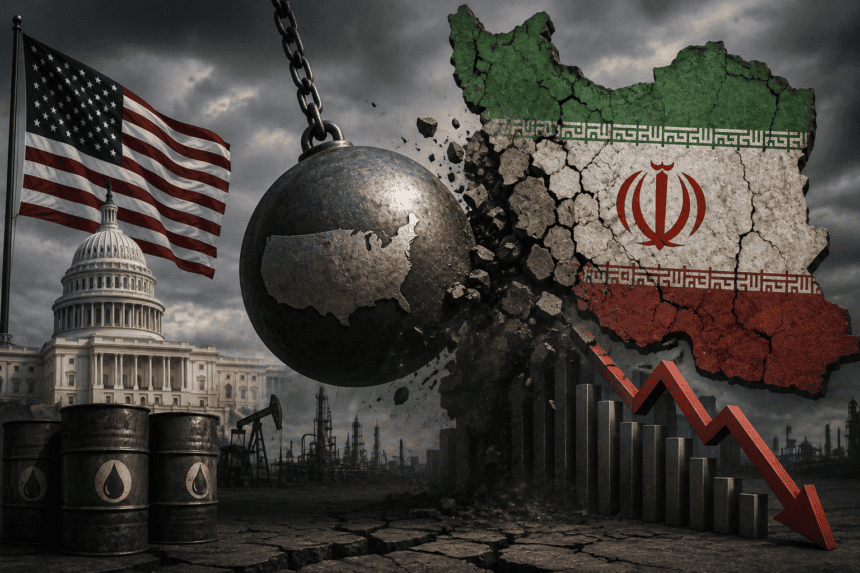
Washington has sharpened its rhetoric against Tehran, with senior officials explicitly framing new, aggressive sanctions as a mechanism to force the Iranian regime into an economic “squash” that could lead to its eventual collapse.
The administration’s strategy marks a departure from previous diplomatic maneuvering, moving away from seeking policy shifts toward actively targeting the fiscal foundations of the state. By tightening the net around oil exports and access to global financial messaging systems, the U.S. aims to isolate the clerical leadership from the capital required to maintain its domestic security apparatus and regional influence.
The “so what” for the average Iranian is immediate. Currency devaluation has already sent the price of basic staples soaring, and the middle class is seeing their savings vanish in real-time. For Washington, this is the intended pressure point. The logic holds that if the regime cannot provide basic economic stability, the internal cost of suppressing dissent will eventually become unsustainable.
“We aren’t just looking at minor adjustments or targeted freezes,” a senior State Department official said, speaking on condition of anonymity to discuss sensitive strategy. “The goal is to render the current economic model non-functional. It’s about creating a reality where the leadership has to choose between its regional ambitions and its own survival.”
The Iranian government has dismissed these threats as “economic terrorism.” Tehran has leaned into its “resistance economy” model, attempting to bypass sanctions through opaque oil-for-goods swaps with regional partners and deepening ties with Moscow and Beijing. However, analysts suggest these stop-gap measures are insufficient to cover the structural deficits created by a near-total loss of conventional export revenue.
This standoff creates a high-stakes gamble for the White House. While officials argue that economic exhaustion is the only path to a stable regional outcome, critics warn that such pressure often hardens the resolve of hardliners, who use the external threat to justify a tighter grip on domestic opposition.
History shows that regimes under severe economic duress rarely fold in a predictable manner. Instead, they often tighten their control, prioritizing the loyalty of security forces while the broader population bears the brunt of the isolation.
As the U.S. moves to implement the next wave of financial restrictions, the focus will shift to how effectively Tehran can continue to trade in the shadows. The regime’s survival now hinges on whether its underground supply lines can outpace the speed of Washington’s economic blockade.