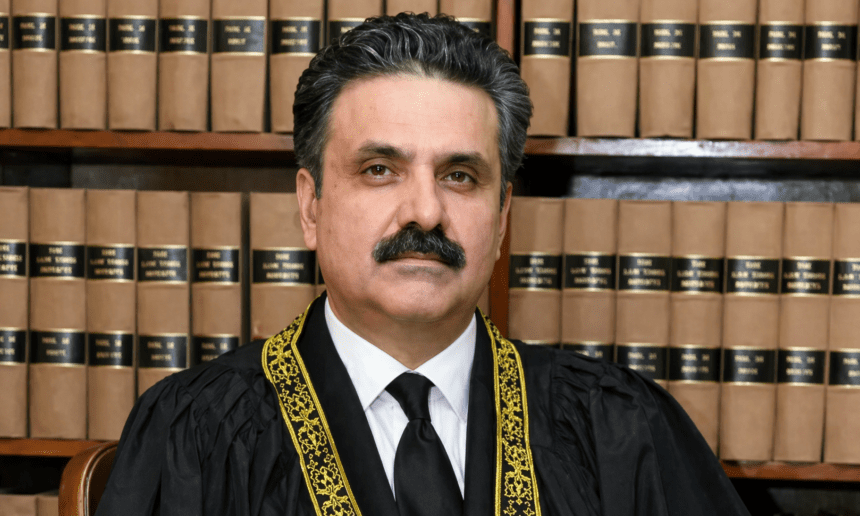
Chief Justice of Pakistan Yahya Afridi has pushed back against a proposal to move a transferred judge from the Islamabad High Court back to the Sindh High Court, saying that such a step would empty the constitutional ideas behind judicial transfers of their real meaning. In his response to a requisition seeking transfers of several Islamabad High Court judges, the CJP argued that sending Justice Khadim Hussain Soomro back to the SHC would weaken the principles of federalism and equitable representation that were cited when judges were moved to the IHC in the first place.
The dispute is tied to a fresh institutional clash over the makeup of the Islamabad High Court. According to Dawn, IHC Chief Justice Sardar Muhammad Sarfraz Dogar had sought a Judicial Commission of Pakistan meeting on April 28 to consider transferring five judges currently serving in the IHC to other high courts. Those names included Justice Mohsin Akhtar Kiani for the Lahore High Court, Justice Babar Sattar for the Peshawar High Court, Justice Arbab Tahir for the Balochistan High Court, and Justices Saman Rafat Imtiaz and Khadim Hussain Soomro for the Sindh High Court.
Afridi’s objection was not framed as a procedural quibble. It was a constitutional one. His position, as reported, is that if judges are transferred to the IHC to reflect the federation’s broader character and then are sent back without a compelling institutional need, the whole exercise starts to look less like a constitutional arrangement and more like an easily reversible administrative posting. That, in his view, would strip the earlier transfer policy of its practical value.
He also pointed to the representational issue. Dawn reported that the CJP said moving both Justice Soomro and Justice Imtiaz to the SHC would leave Sindh without representation in the Islamabad High Court. He further noted that the requisition, in his view, did not set out clear reasons or an institutional necessity strong enough to justify the requested transfers. In that context, he warned that an unexplained transfer request could take on a punitive character, effectively amounting to the removal of a judge from office in practice, even if not in formal legal terms.
This latest exchange lands in the middle of a longer and already bitter controversy over judicial transfers under Article 200 of the Constitution. In February 2025, Justice Sarfraz Dogar from the Lahore High Court, Justice Khadim Hussain Soomro from the Sindh High Court, and Justice Muhammad Asif from the Balochistan High Court were transferred to the IHC. That triggered legal challenges from five IHC judges and bar bodies, largely over the constitutionality of the transfers and the seniority consequences that followed.
The background matters because the state had defended those transfers as part of the IHC’s federal character. In filings before the court, the Sindh High Court registrar said Justice Soomro’s transfer process was initiated through a law ministry letter under Article 200, with the concurrence of the SHC chief justice and Justice Soomro’s consent. The federal government also argued during those proceedings that the IHC should function as a representative court and that its composition should reflect the federation.
That constitutional fight reached a major milestone in June 2025, when the Supreme Court’s Constitutional Bench ruled by a 3-2 majority that the transfers of judges to the IHC were not unconstitutional. The bench said a transfer under Article 200 could not be treated as a fresh appointment, and it left the seniority and nature of the transferred judges’ posting to be determined through presidential notification or order.
So this is not just about one judge, or even five. It is really about what judicial transfer is supposed to achieve in Pakistan’s constitutional design. Afridi’s latest response makes that pretty plain: if inter-high-court transfers are meant to serve federal balance and representation, then reversing one without a strong constitutional reason risks making the whole idea look hollow. The legal and institutional fallout from that argument could shape the next phase of the IHC transfer saga.