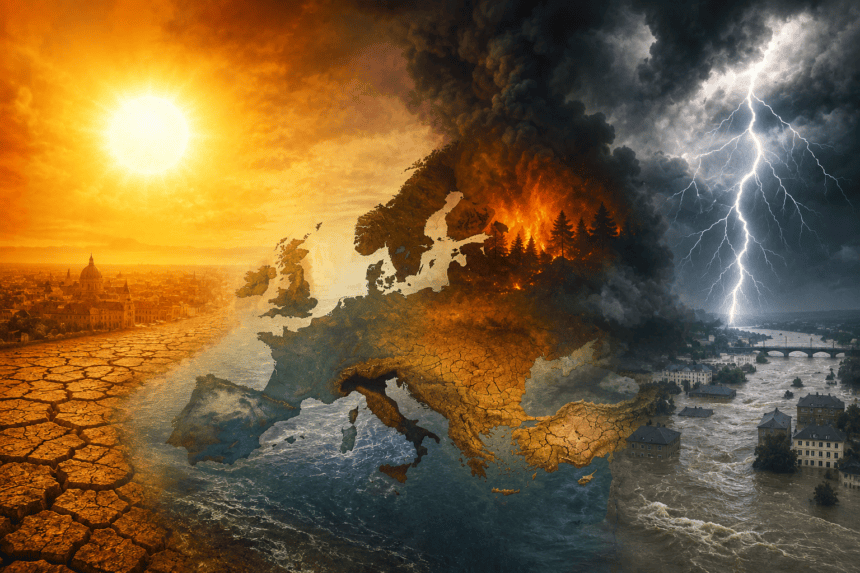
Europe is enduring a season of extremes. From the scorched hillsides of the Mediterranean to the waterlogged streets of Central Europe, the continent is witnessing a violent shift in weather patterns that is testing the limits of its infrastructure and its political resolve.
This isn’t a distant forecast anymore. It’s the reality of a continent trapped between record-shattering heatwaves and flash floods that defy historical averages.
The human cost is mounting. In Greece and Spain, fire crews have spent weeks battling wildfires that move with unprecedented speed, fueled by parched vegetation and relentless winds. Meanwhile, countries like Germany and Poland are grappling with sudden, intense rainfall that has turned once-stable rivers into destructive torrents, overwhelming drainage systems never designed for this volume of water.
The numbers are stark. Copernicus, the European Union’s climate monitoring service, has confirmed that the past twelve months have consistently breached temperature records. Scientists point to the Atlantic’s record-breaking sea surface temperatures as a primary driver, acting as a massive heat engine that feeds both the drought-stricken South and the storm-battered North.
“We are seeing the boundaries of our safety margins disappear,” says Dr. Elena Rossi, a climate researcher based in Milan. “The infrastructure we built fifty years ago assumes a level of stability that no longer exists. We aren’t just adjusting for a bad year; we’re adjusting for a new, volatile baseline.”
Politically, the summer has forced a shift in focus. The European Green Deal, once a roadmap for long-term policy, is now being scrutinized through the lens of immediate survival. Critics argue that adaptation efforts—such as forest management and flood defense upgrades—have lagged behind the pace of the climate’s deterioration.
Governments are now caught in a difficult cycle: they are forced to spend billions on emergency disaster relief, which drains the very budgets intended for the transition to renewable energy. It is a feedback loop that threatens to stall the continent’s climate goals just as they become most critical.
The economic fallout is becoming impossible to ignore. Tourism, a cornerstone of the Mediterranean economy, is stuttering as heat warnings keep visitors away. Agriculture is facing a similar crisis, with crop yields in Italy and France suffering from a combination of prolonged soil moisture deficits and sudden, crop-destroying hailstorms.
The question for European policymakers is no longer whether to act, but how to pivot from reactionary crisis management to a hardened, resilient infrastructure. As the autumn approaches, the damage from this summer serves as a blunt reminder that the continent’s climate reckoning isn’t coming—it’s already here.