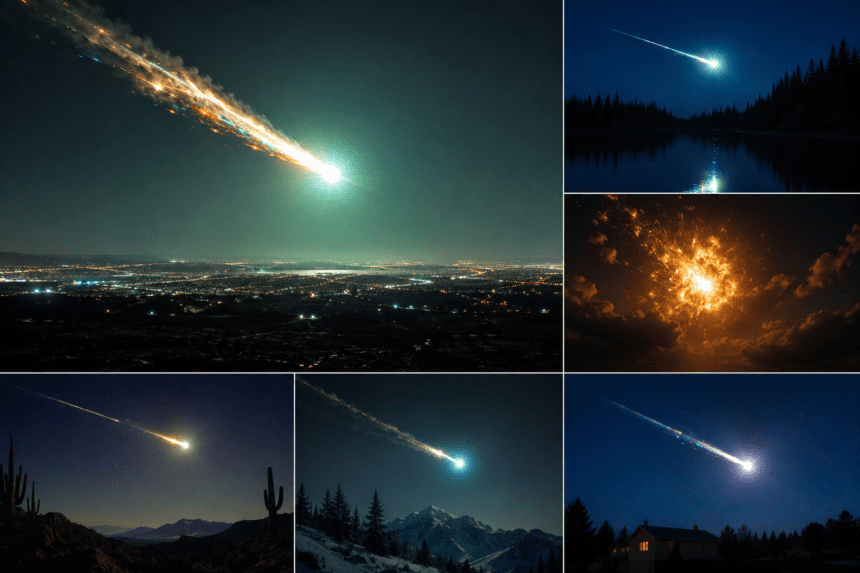
A brilliant flash of light turned the night sky into a neon spectacle across parts of the United States late Tuesday, as a suspected bolide—a meteor that explodes in the atmosphere—shattered the darkness. Thousands of reports flooded the American Meteor Society’s tracking portal within minutes of the event, with sightings stretching from the Midwest to the Eastern Seaboard.
The fireball, which witnesses described as a “pulsing, electric blue streak,” appeared around 11:30 p.m. local time. Security cameras and dashcams captured the object descending rapidly before fracturing into several glowing fragments. It didn’t just light up the sky; it rattled nerves.
“It looked like a flare, then it turned into a blinding white light that seemed to pulse before it just vanished,” said Mark Henderson, a late-shift worker who saw the phenomenon from a highway overpass in Ohio. “I thought it was a plane coming down until the colors started shifting.”
While meteor sightings are common, the sheer scale of this event has drawn immediate interest from astronomers. Most space rocks burn up as small “shooting stars,” but this object possessed enough mass to penetrate deep into the lower atmosphere. The resulting sonic boom—reported by residents in at least three states—suggests the object was significantly larger than the average pebble-sized debris that typically hits Earth’s orbit.
Data from the National Weather Service radar systems in the region picked up a distinct signature consistent with high-altitude debris, confirming the object’s trajectory. Experts are now working to triangulate the impact zone, though they warn that most of the material likely vaporized long before hitting the ground.
This isn’t an isolated incident, but the intensity of the light—a byproduct of the object’s chemical composition—is what sets this event apart. Magnesium-rich meteors often burn with a distinct blue or green hue, providing a rare visual display that outshines even the brightest satellites.
For now, the focus shifts to locating potential fragments. If any pieces survived the heat of atmospheric entry, they are currently scattered across a debris field that researchers are scrambling to map. Until then, the only evidence remains in the hundreds of clips circulating on social media, showing a moment where the night sky turned briefly into high noon.