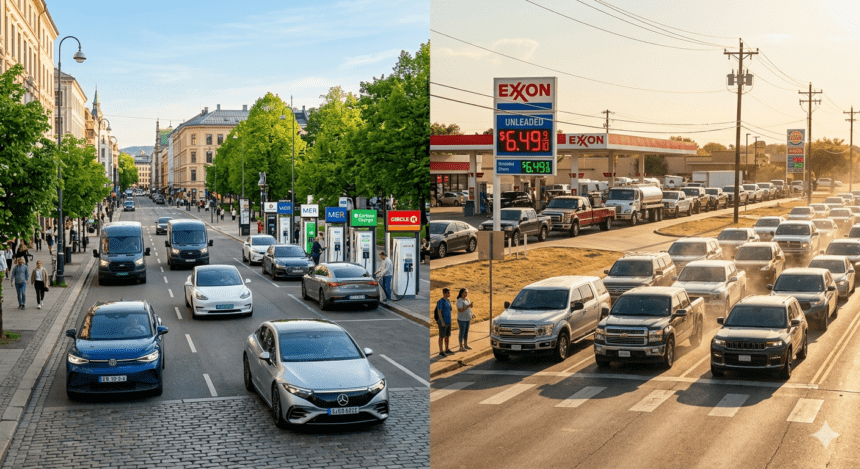
High fuel costs are accelerating the global shift to electric vehicles, but American drivers aren’t joining the trend. While Europe and China see record adoption rates driven by volatile gas prices, the U.S. market remains stuck in a holding pattern.
In Europe, the math is simple: charging an EV costs a fraction of filling a tank. With fuel prices across the continent hovering at historic highs, consumers are cutting their losses and trading in internal combustion engines. China’s state-backed subsidies and a massive infrastructure push have turned EVs from a luxury choice into the default option for middle-class commuters.
The U.S. story is different. Despite gas prices often topping $4 a gallon in key markets, the American transition is hitting a wall. Infrastructure remains the primary culprit. A driver in Oslo can find a reliable, high-speed charger every few miles. A driver in rural Nebraska? They’re looking at a multi-hour detour just to find a plug that might not work.
Then there is the issue of vehicle type. U.S. demand is heavily skewed toward large SUVs and trucks. Most EV makers are still struggling to build electric versions of these vehicles that don’t cost a fortune. Consumers aren’t willing to downsize to a compact sedan just to save on fuel, and until the price-to-utility gap closes, they’re choosing to pay at the pump.
Politics also plays a role. In the U.S., the electric car has become a cultural proxy. Policy shifts and the constant noise around federal tax credits create a sense of uncertainty for buyers. When a car purchase is a decade-long commitment, uncertainty is the enemy of sales.
“The consumer isn’t rejecting the technology; they’re rejecting the inconvenience,” says auto analyst Sarah Jenkins. “Until you can pull into a station and charge with the same ease as pumping gas, the price of fuel won’t be enough to tip the scales for the average American buyer.”
For now, the U.S. remains an outlier. While the rest of the world views the EV as a hedge against rising energy costs, Americans are still betting on the pump—mostly because they feel they have no other choice.