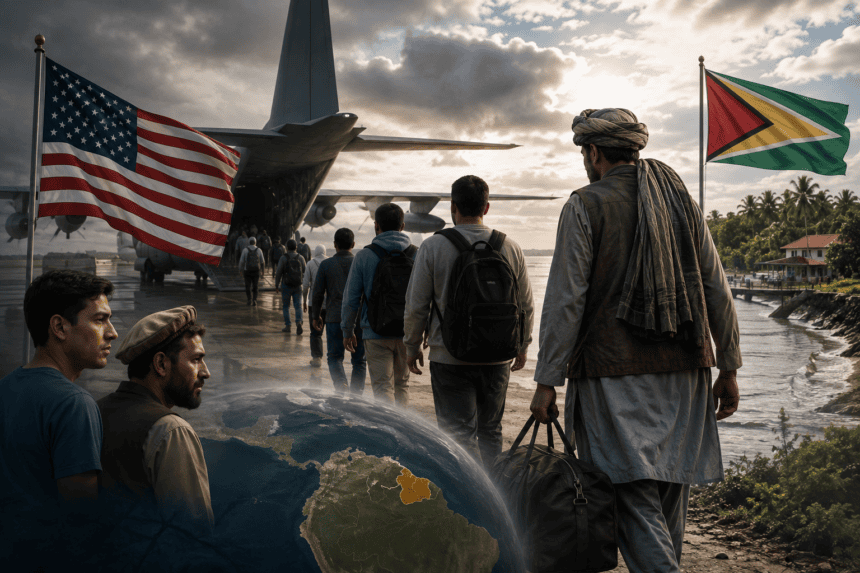
GEORGETOWN — A group of Cuban and Afghan nationals arrived at Cheddi Jagan International Airport on Tuesday, marking the first wave of deportations under the Trump administration’s tightened immigration enforcement policy.
The flight, chartered by U.S. Immigration and Customs Enforcement (ICE), touched down shortly before dawn. Local Guyanese officials, caught off guard by the sudden arrival, scrambled to coordinate with international aid agencies to process the individuals.
The detainees—comprised of families and single adults—were held in U.S. facilities before being transferred to Guyana. While the U.S. government has cited regional transit agreements to justify the move, the sudden relocation has strained Guyana’s limited border processing capacity.
“We are managing a situation we didn’t create,” a senior Guyanese immigration official said, speaking on condition of anonymity. “Our team is currently identifying the specific status of each individual, but we have no existing infrastructure for this volume of arrivals.”
For the Afghans on board, many of whom fled the Taliban takeover in 2021, the deportation represents a sudden end to their asylum claims. Legal advocates in Washington have criticized the move, arguing that the U.S. is bypassing traditional asylum protocols by offloading migrants to a third country that lacks the legal framework to handle long-term refugee resettlement.
The U.S. Department of Homeland Security has maintained that the removals are consistent with new administrative directives aimed at curbing illegal border crossings. Officials claim the policy is intended to “decentralize” the pressure on the U.S.-Mexico border by utilizing regional partners.
Human rights observers, however, see a different pattern. The lack of transparent communication between Washington and Georgetown regarding the flight’s manifest has raised alarms among regional NGOs. They argue that the sudden drop-off of vulnerable populations in a country already struggling with its own migration influx is a geopolitical gamble with human lives.
As of Tuesday evening, the migrants remained in a holding area near the airport. The Guyanese government is expected to hold an emergency cabinet meeting Wednesday to determine whether these individuals will be granted temporary work permits or processed for repatriation to their home countries.
For the families now stranded in Georgetown, the uncertainty is absolute. They landed in a country they did not choose, thousands of miles from the borders they risked everything to reach, with no clear path to asylum and nowhere else to go.