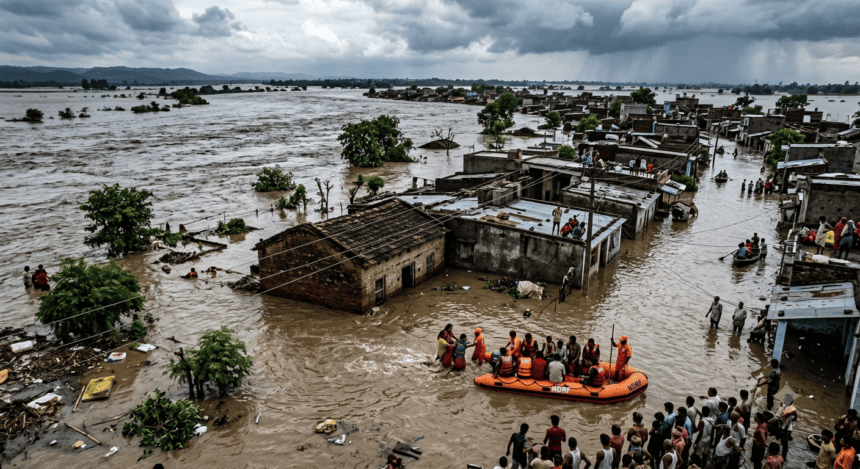
The monsoon season has turned lethal across northern India, where flash floods and landslides have claimed at least 40 lives over the past 72 hours. From the steep slopes of Himachal Pradesh to the riverbanks in Uttarakhand, thousands remain stranded as rescue teams battle rising water levels and blocked mountain passes.
The surge began Thursday night. Intense, unceasing rainfall triggered a series of landslides that wiped out arterial roads, cutting off dozens of remote villages. In Himachal Pradesh alone, authorities confirmed 22 deaths by Sunday morning. The state’s disaster management department reported that several homes were swept away while residents slept, leaving emergency responders struggling to reach survivors in the debris.
For those living in these mountainous regions, the devastation feels familiar. Infrastructure—built to withstand moderate rain—is buckling under the weight of increasingly erratic weather patterns.
“We lost everything in thirty minutes,” said Ravi Kumar, a resident of a village near Mandi, whose home was buried under mud and rock. “The water didn’t just rise; it roared down the mountain like a freight train.”
State officials are now under mounting pressure to explain why early warnings failed to reach the most vulnerable areas. While the India Meteorological Department (IMD) issued orange and red alerts for the region, communication blackouts caused by downed power lines left many communities entirely isolated.
In the plains, the situation is equally dire. Rivers have breached their banks, flooding agricultural fields and destroying crops ahead of the harvest season. In parts of Punjab and Haryana, authorities have opened floodgates on major dams to prevent structural failure, further exacerbating the flooding in low-lying districts downstream.
The National Disaster Response Force (NDRF) has deployed 15 additional teams to coordinate search and rescue operations. Using drones and heavy machinery, they are working to clear mountain roads that remain choked with silt and boulders.
Despite the massive deployment, the forecast offers little hope for immediate relief. Meteorologists expect heavy rainfall to persist across the Himalayan foothills for at least another 48 hours. With soil already saturated, the risk of further landslides remains extreme, threatening to complicate rescue efforts and keep thousands in the path of the rising water.