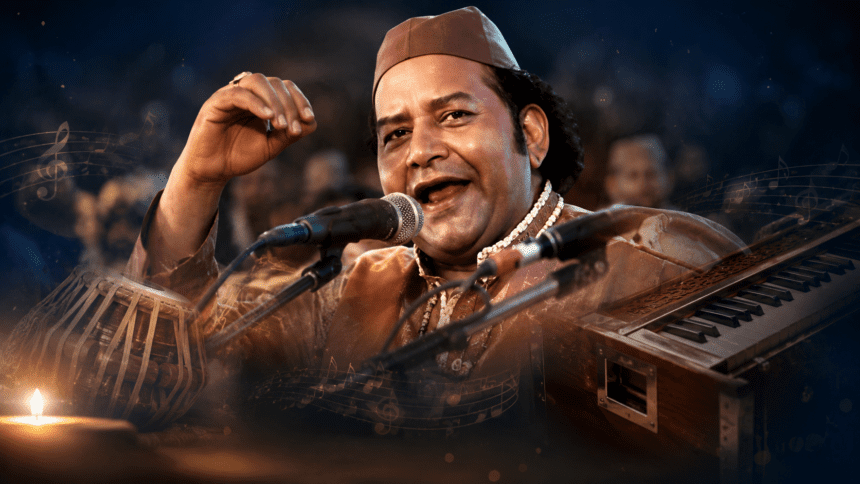
Nazir Faridi, the voice that anchored decades of traditional Qawwali and Sufi devotion, died in Karachi on Tuesday following a prolonged illness. He was 65.
His family confirmed the passing, ending a career that spanned over forty years. Faridi had been battling complications related to a chronic respiratory ailment for several months, with his health deteriorating sharply over the past two weeks.
Known for his command over the classical Sufi repertoire and his ability to hold a crowd with nothing but a harmonium and a haunting, rhythmic cadence, Faridi occupied a quiet but essential corner of Pakistan’s musical landscape. While he avoided the high-octane, televised fame of modern pop-Qawwali, his following remained devout. He was a staple at major shrines across Sindh and Punjab, where his performances were less about spectacle and more about the traditional, meditative roots of the art form.
“He didn’t just sing the kalam; he lived the pain inside it,” said Ustad Ghulam Hussain, a contemporary who performed alongside Faridi in the early 1990s. “In an era of stage theatrics, he remained a purist. He believed the microphone was a secondary tool, not the primary one.”
Faridi rose to prominence in the late 1980s, gaining recognition for his renditions of Amir Khusrau’s poetry and the distinct “Faridi” style of vocal improvisation that emphasized breath control and emotional restraint. His career was marked by a steady refusal to deviate from the traditional Qawwali framework, often distancing himself from the commercial fusion trends that defined the industry in the 2000s.
His health struggles were no secret to the local music fraternity, which had organized a small fundraiser earlier this year to assist with mounting medical bills. Despite these efforts, his condition remained fragile.
The void he leaves is not just in the list of active performers, but in the preservation of a specific, non-commercialized approach to Sufi music. His funeral prayers are scheduled for Wednesday afternoon in Karachi, where he will be laid to rest.
For the students he mentored at his private conservatory, the focus now shifts to whether the nuances of his particular style—the subtle tonal shifts and the deep, guttural delivery—will survive his absence.