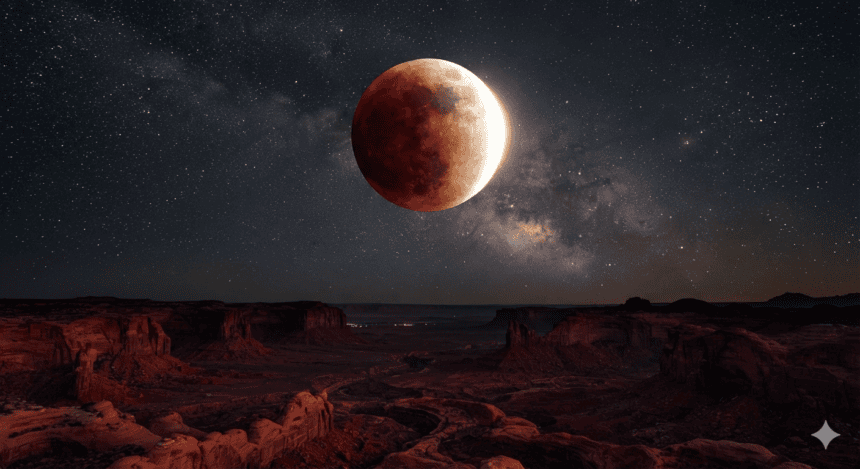
The Earth slid between the Sun and the Moon early Wednesday, casting a shadow that turned the lunar surface into a deep, blood-red spectacle for observers across parts of Europe, Africa, and Asia.
This celestial alignment—known as a partial lunar eclipse—occurs when the Earth’s shadow covers only a fraction of the Moon. Unlike a total eclipse where the Moon vanishes into darkness, this event left a jagged, dark bite taken out of the lunar disk, while the rest of the surface glowed with a bruised, coppery hue.
The phenomenon relies on Rayleigh scattering. As sunlight passes through the Earth’s atmosphere, blue light waves are filtered out, leaving longer, redder wavelengths to bend toward the Moon. The result isn’t just a shadow; it’s a filtered projection of every sunrise and sunset happening on Earth at that exact moment, splashed across the lunar landscape.
For professional astronomers, the event served as a routine calibration exercise. For the millions watching from rooftops and darkened parks, it offered a rare look at the mechanics of our solar system. In cities with clear skies, the transition was visible to the naked eye, requiring no specialized equipment—a sharp contrast to the safety precautions needed for solar eclipses.
While the visual impact was striking, this eclipse was relatively modest in duration compared to the “Super Blue Moon” events that occasionally dominate headlines. The Earth’s umbra—the darkest part of its shadow—only grazed the lunar limb, meaning the most intense coloring was confined to a localized region rather than the entire disk.
Observers in parts of the Americas missed the show entirely, as the Moon remained below the horizon during the peak of the alignment. For those who did catch it, the view lasted roughly an hour before the Moon drifted clear of the Earth’s penumbra, returning to its familiar, pearly white brilliance.
The next opportunity for a similar display arrives in early 2025, when a total lunar eclipse will provide a deeper, more uniform shade of red across the entire lunar surface. Until then, Wednesday’s partial shading remains a reminder of the constant, quiet dance between our planet and its only natural satellite.