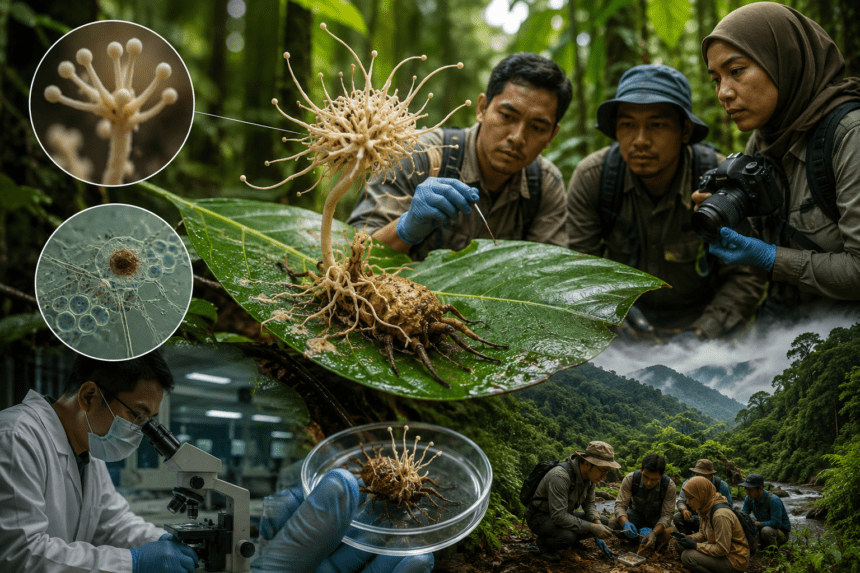
Deep in the humid canopy of Borneo’s primary rainforests, Malaysian researchers have uncovered a hyperparasitic fungus—a discovery that challenges existing understanding of how forest ecosystems regulate their own biodiversity.
The fungus, identified during a recent biodiversity survey, doesn’t just attack plants or insects; it targets other parasitic fungi already living on host plants. It is a parasite of a parasite, effectively acting as a biological control agent in the dense, competitive environment of the jungle floor.
“We are looking at a hidden layer of complexity,” said Dr. Siti Aminah, the lead researcher on the project. “It isn’t just about who eats whom. It’s about how these micro-organisms keep the forest’s fungal populations in check.”
The discovery came after months of tracking fungal spores across three distinct forest tracts in Sabah. While hyperparasites have been documented in laboratory settings or controlled agricultural environments, observing them functioning in the wild, chaotic reality of a tropical rainforest is rare.
For the broader ecosystem, this is a significant find. If these fungi are responsible for curbing the spread of other, more destructive parasitic species, they play a vital role in maintaining the health of the trees and plants that make up the world’s oldest rainforests.
However, the team cautioned that these fungi are incredibly sensitive to environmental changes. As deforestation and climate shifts alter the humidity and temperature profiles of the Borneo jungle, these microscopic regulators risk disappearing before they are fully understood.
The research team is now moving to map the distribution of the fungus, hoping to determine if it exists in more degraded forest areas or if it is strictly confined to primary, untouched growth.
“We’ve only scratched the surface,” Dr. Aminah said. “If we lose these species, we lose the forest’s internal immune system.”