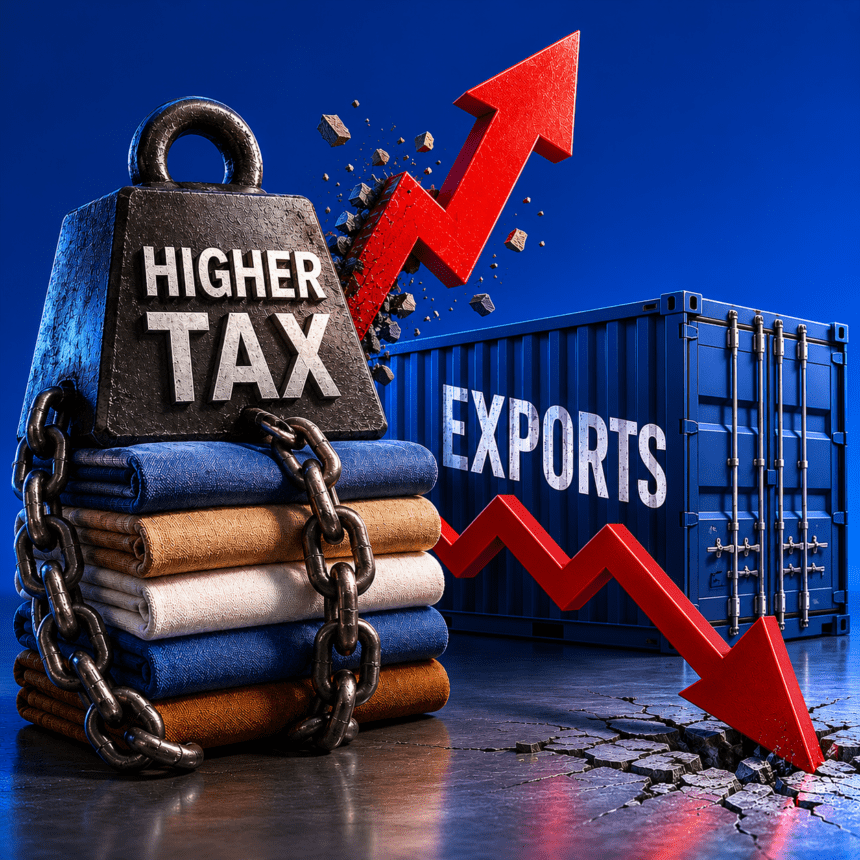
ISLAMABAD: Pakistan’s textile industry has warned the federal government that exporters are being squeezed by an effective tax burden of up to 113%, saying the current regime is hurting competitiveness, weakening cash flows and making it harder for the country’s biggest export sector to hold ground in global markets.
The warning comes ahead of the FY2026-27 federal budget, as textile and apparel exporters press Prime Minister Shehbaz Sharif’s government for urgent tax, energy and refund reforms. Industry representatives argue that Pakistan’s exporters are being taxed not just on profits, but in ways that punish turnover, thin margins and delayed payments.
At the centre of the complaint is the 2% advance tax on gross export proceeds. Textile bodies say the levy is especially damaging for exporters operating on narrow margins. For a business earning a 3% profit margin, a 2% tax on turnover can eat up nearly two-thirds of annual profit before other taxes and charges are even counted.
That, the industry says, is where the pressure becomes unbearable.
According to figures cited by textile groups, exporters face layers of corporate income tax, super tax, workers’ welfare contributions, profit participation obligations, provincial social security charges and advance tax on export proceeds. Earlier industry submissions had placed the effective burden at around 68.27%, but a fresh Pakistan Textile Council presentation warned that the burden can rise as high as 113% in some cases.
Exporters say the comparison with regional competitors is stark. The Pakistan Textile Council has argued that the effective tax burden on textile exporters is far lower in competing economies, including about 20% in Vietnam, 28% in Bangladesh and 35% in India. For an industry fighting for orders from global buyers, that gap is not just a statistic. It decides whether a Pakistani factory gets the next contract — or loses it.
The sector’s message to the government is blunt: exports can’t grow if exporters are taxed out of working capital.
Textile manufacturers are also demanding lower and regionally competitive energy tariffs. Power and gas costs have remained one of the industry’s biggest complaints, particularly for spinning, weaving, dyeing and finishing units where energy is a major part of production cost. High electricity prices, they argue, make Pakistani products more expensive even before they reach international buyers.
There is another old sore point too: delayed refunds. Exporters say stuck sales tax and other refunds keep billions of rupees out of business circulation, forcing companies to borrow at high interest rates just to run routine operations. In a sector where buyers demand tight delivery schedules and margins are often painfully thin, cash flow delays can quickly become missed shipments, cancelled orders and layoffs.
The industry has asked the government to abolish or reduce the super tax, bring down the minimum turnover tax, clear pending refunds, restore export-related incentives and consult stakeholders before finalising budget measures. Textile leaders also want Islamabad to take up the issue with the International Monetary Fund, since many revenue decisions are being shaped by Pakistan’s wider fiscal commitments.
The stakes are high. Textiles remain Pakistan’s most important export engine, supporting millions of jobs across cotton, yarn, fabric, garments, towels, denim, knitwear and home textiles. The sector also brings in a large share of the country’s foreign exchange at a time when Pakistan continues to face pressure on external financing and reserves.
Industry officials warn that if the tax structure is not corrected in the upcoming budget, Pakistan may continue losing export orders to Bangladesh, Vietnam and India. Some exporters say buyers have already become more price-sensitive, and even a small cost difference can push orders elsewhere.
For the government, the dilemma is familiar. Islamabad needs revenue to manage the deficit and satisfy lenders. But squeezing export sectors too hard can weaken the very industries that bring dollars into the country. Textile exporters say this is exactly the trap Pakistan now risks falling into.
The FY27 budget will show whether the government treats the textile sector’s warning as routine lobbying — or as a serious alarm from an industry that still carries much of Pakistan’s export economy on its shoulders.