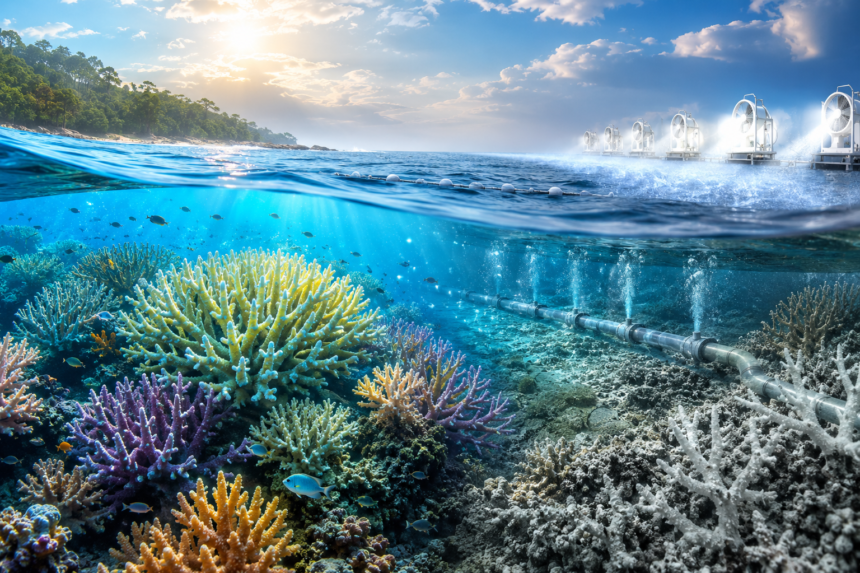
Marine biologists are no longer waiting for global carbon emissions to drop. With coral bleaching events becoming annual occurrences rather than decadal anomalies, researchers are pivoting to aggressive, hands-on interventions: breeding “super corals” and shading the sea.
The strategy marks a shift from passive conservation to active engineering. Scientists at the Australian Institute of Marine Science are currently cross-breeding heat-tolerant coral colonies, selecting for genetic traits that allow them to survive in water temperatures three degrees Celsius higher than what their ancestors endured.
It’s an evolutionary shortcut. By identifying heat-resistant genes and accelerating their spread, researchers hope to create reefs capable of withstanding the inevitable temperature spikes of the next two decades.
“We aren’t trying to replace the entire ecosystem,” says Dr. Elena Rossi, a lead researcher on the project. “We’re trying to buy time. If we can keep the structural foundation of the reef alive, the rest of the biodiversity has a fighting chance.”
But biology has limits. Even the most resilient coral eventually hits a thermal threshold.
This is where the second front of the battle begins: localized cooling. Engineers are testing “marine cloud brightening”—a process involving specialized ships that spray a fine mist of salt water into the air above reefs. The sea salt particles seed clouds, making them whiter and more reflective. The goal is simple: bounce more sunlight back into space to drop the water temperature by a fraction of a degree.
The data remains preliminary, but initial trials on the Great Barrier Reef suggest a localized cooling effect is possible. The challenge isn’t just the physics; it’s the scale.
Critics argue that these interventions are merely expensive bandages on a terminal wound. If ocean temperatures continue their current trajectory, the energy required to “shade” massive reef systems becomes unsustainable. There’s also the risk of ecological side effects—altering local weather patterns or introducing genetic bottlenecks by favoring only heat-tolerant species.
For now, the focus is on “managed retreat” and triage. Conservationists are identifying high-value reef zones—areas with high biodiversity or critical economic importance—and prioritizing them for these interventions.
The strategy is a gamble against time. Whether these engineered corals and cloud-brightening ships can hold the line depends on how quickly the world addresses the warming trend itself.
“We are building a life raft,” one researcher noted during a recent briefing. “But a life raft only works if you’re actually moving toward a shore.”