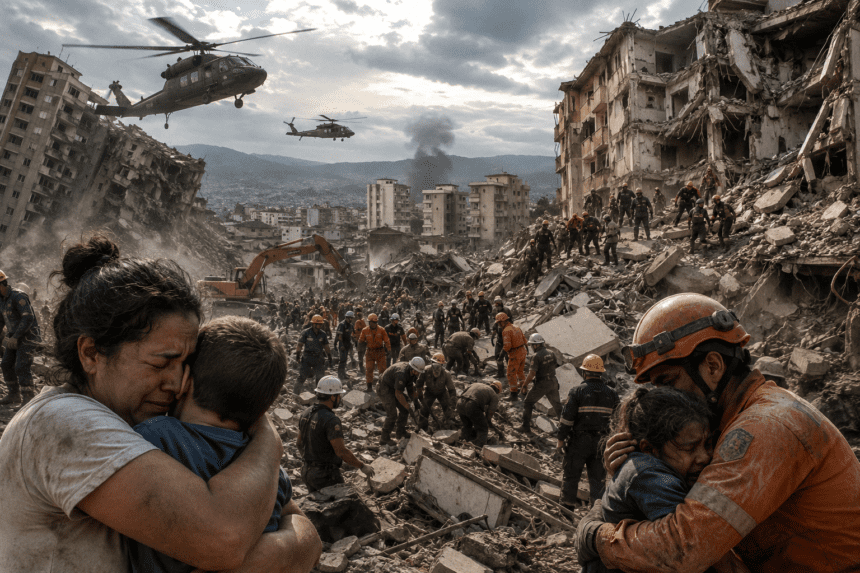
CARACAS — Rescue teams are digging through a landscape of pulverized concrete and twisted steel today after two massive, back-to-back earthquakes rocked Venezuela’s most densely populated regions.
The death toll remains unconfirmed, but government officials and international observers warn the number will reach into the thousands. Entire neighborhoods in the capital and surrounding coastal towns have been reduced to rubble.
The first tremor, a magnitude 7.6, hit at 4:12 a.m. local time, catching millions in their sleep. A second quake, registering 7.2, struck three hours later as survivors scrambled into the streets. The epicenter was centered just 40 miles north of Caracas, triggering landslides that have effectively severed the country’s main supply arteries.
“We are looking at a catastrophe of historic proportions,” said Maria Elena Rojas, a lead coordinator for the Red Cross on the ground. “The hospitals are overwhelmed, the power grid is gone, and we are still hearing voices under the debris.”
The scale of the destruction has prompted a rare, rapid-fire response from the international community. The United Nations is coordinating a massive logistics chain, while search-and-rescue teams from Mexico, Brazil, and Spain have already begun arriving at Simon Bolivar International Airport. Despite the political friction that has long defined Venezuela’s foreign relations, regional neighbors are rushing to provide medical supplies, portable water filtration units, and heavy lifting equipment.
For those trapped, however, the clock is the enemy. Local emergency services were already operating with limited resources before the quakes hit. Now, with major bridges collapsed and phone lines dead, reaching remote mountain villages has become nearly impossible.
“My house is gone, my brother is gone, and I don’t know where to turn,” said Luis Mendez, a resident of a shattered suburb near the epicenter. He stood near a pile of rebar that was once his home, waiting for rescue crews that haven’t yet reached his street.
The government has declared a 30-day state of emergency. President Nicolas Maduro appeared on state television early this morning, calling for unity. He pledged to accept all international assistance to stabilize the situation.
As the sun sets, the focus shifts to the search for survivors in the dark. With temperatures dropping and the threat of aftershocks looming, the humanitarian mission is only just beginning. The question for the coming days isn’t just how many died, but how a country already struggling with infrastructure can recover from a disaster of this magnitude.