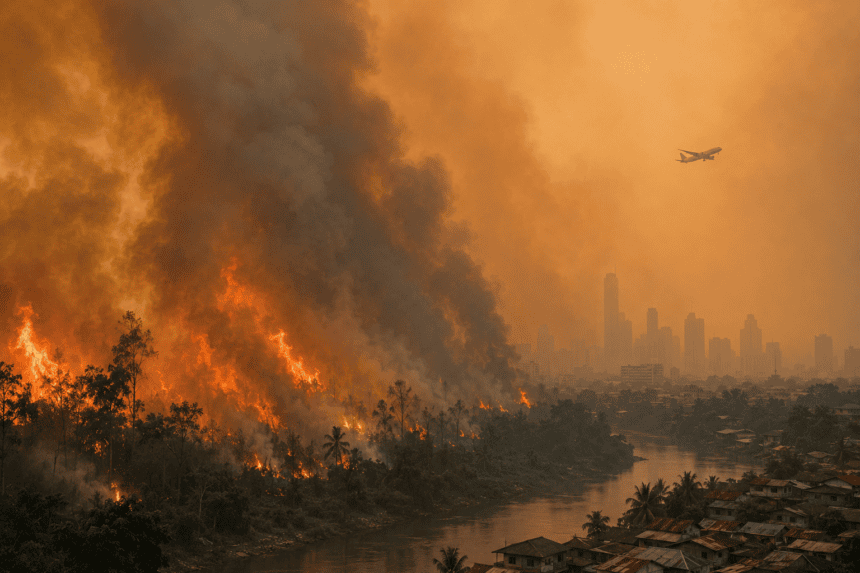
Thick, acrid smoke from peatland fires in Indonesia is choking cities across Southeast Asia, pushing air quality to hazardous levels and reigniting a long-standing regional diplomatic crisis.
The haze, thickest over Sumatra and Kalimantan, has drifted across the Malacca Strait, blanketing parts of Malaysia and Singapore in a grey, toxic fog. Schools in the worst-hit Indonesian provinces have shuttered, and local hospitals are bracing for a surge in patients suffering from acute respiratory infections.
For residents in Jambi and Riau, the air isn’t just unpleasant—it’s dangerous. Monitoring stations recorded PM2.5 levels at several times the World Health Organization’s recommended safety limit. Visibility in some areas has dropped to less than 100 meters, grounding flights and forcing commuters to wear N95 masks just to navigate their own neighborhoods.
The fires are primarily driven by “slash-and-burn” agriculture. Smallholder farmers and commercial palm oil plantations clear land by setting it ablaze, a cheap but devastating method that frequently spirals out of control during the dry season. Peatlands, which are carbon-rich and highly flammable, act as fuel for these fires, turning manageable brush burns into massive, stubborn infernos that can smolder underground for weeks.
Indonesia’s forestry ministry claims it has deployed thousands of personnel and water-bombing aircraft to contain the hotspots. Yet, the scale of the destruction suggests the response is reactive rather than preventative. Critics argue that enforcement against powerful plantation companies remains weak, with local authorities often turning a blind eye to land-clearing violations until the smoke reaches a breaking point.
This isn’t a new fight. Regional neighbors, particularly Malaysia and Singapore, have spent decades pressuring Jakarta to impose stricter penalties on companies responsible for the transboundary haze. While Indonesia has occasionally revoked operating licenses, the seasonal cycle of burning has proven remarkably resilient to government policy.
As the dry season persists, satellite imagery shows a growing number of hotspots, indicating that the worst of the haze may still be ahead. For the millions living under the smog, the immediate concern isn’t policy or politics—it’s the next breath.