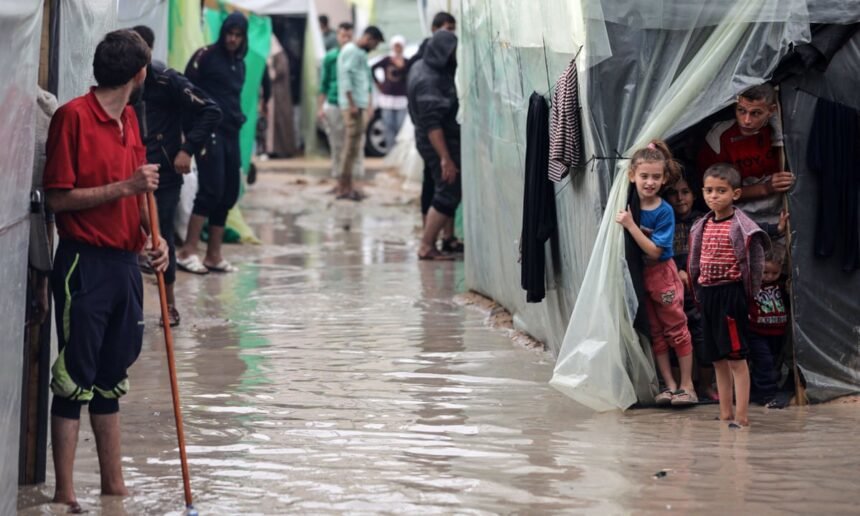
Hundreds of thousands of displaced Palestinians in Gaza are facing rising floodwaters after days of heavy rain, with the UN warning that shelter materials are still blocked from entering the enclave. A baby girl has died from exposure, and at least 12 people are reported dead or missing due to the storm, local officials confirmed on Friday.
According to the UN’s International Organization for Migration (IOM), nearly 795,000 displaced people are at immediate risk as their makeshift shelters sit in low lying, debris-filled areas with little drainage. The downpour has already flooded 27,000 tents, destroyed belongings, and caused 13 buildings to collapse, deepening fears of disease outbreaks due to poor waste management.
Families displaced by two years of war struggled through ankle-deep waters in camps across Nuseirat on Thursday. Mattresses, clothes and food supplies were soaked as people attempted to clear water using buckets and bowls—an effort mostly in vain.
Fifty-year-old Youssef Tawtah, standing near a drenched mattress, described a night of fear and exhaustion. “All night long the children and I stayed on our feet. How can they bear this? Our food is ruined,” he said while his family huddled around a small fire.
The IOM said essential materials—timber, plywood, sandbags, and water pumps—remain blocked due to access restrictions. Israel insists it is meeting its humanitarian obligations and accuses aid agencies of inefficiency, while aid groups deny the claims.
Although a ceasefire has largely held since October, Gaza’s infrastructure remains devastated, leaving 1.5 million people displaced and at least 300,000 new tents urgently needed, officials said.
The World Health Organization also raised concerns for more than 4,000 people living in high-risk coastal zones battered by waves. WHO warned of severe health dangers in these rubbish-strewn, unprotected areas where families are exposed to pollution and stagnant water.
With winter approaching and supplies failing to withstand the harsh weather, the UN says families are trying to shield their children “with whatever they have,” as the humanitarian crisis deepens further.