By using this site, you agree to the Privacy Policy and Terms of Use.
Accept
Media HydeMedia Hyde
  • Home
  • Politics
  • Education
  • Entertainment
  • Sports
  • Blogs
  • Business & Commerce
  • Others
    • Religious
    • Metropolitan
    • Climate and Weather
Font ResizerAa
Media HydeMedia Hyde
Font ResizerAa
  • Home
  • Politics
  • Education
  • Entertainment
  • Sports
  • Blogs
  • Business & Commerce
  • Others
    • Religious
    • Metropolitan
    • Climate and Weather
Follow US
© 2026 Media Hyde Network. All Rights Reserved.
international

High Security in Islamabad’s Red Zone During Iranian Delegation’s Visit

Last updated: April 25, 2026 4:08 pm
Amna Iqbal
Share
SHARE

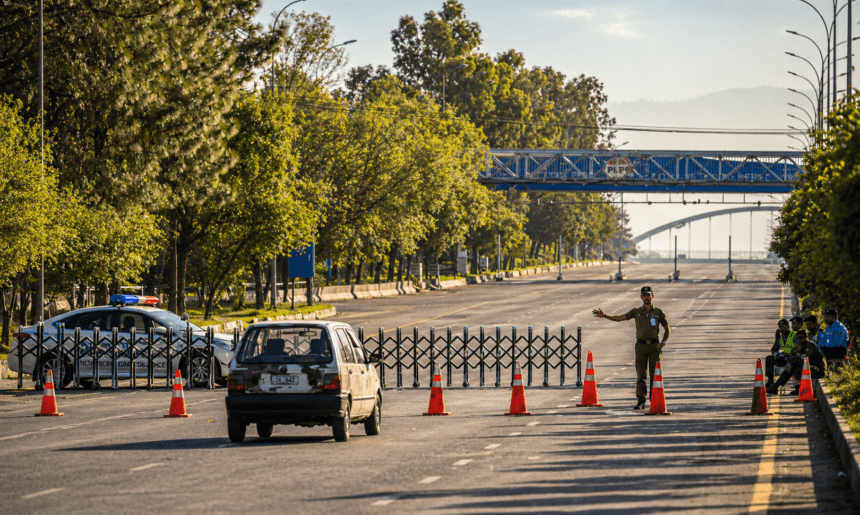
ISLAMABAD, April 25: Islamabad’s Red Zone remained under unusually tight security on Saturday as a high-level Iranian delegation led by Foreign Minister Abbas Araghchi visited the Pakistani capital for talks with senior leadership, prompting road closures, barricades and a heavy police presence across the city’s most sensitive administrative zone.

Police were deployed in large numbers on key arteries leading into the Red Zone, while access to several routes was restricted as part of an expanded security plan for the visit. Visual reporting from the area showed roads sealed with barriers and officers stationed at major intersections, underscoring the level of caution authorities attached to the Iranian delegation’s presence in Islamabad.

Pakistan’s Foreign Office had announced ahead of the visit that Araghchi was arriving for a two-day official trip and was scheduled to meet Prime Minister Shehbaz Sharif and Deputy Prime Minister and Foreign Minister Ishaq Dar. According to the ministry, the discussions were expected to cover both Pakistan-Iran bilateral relations and the broader situation in the Middle East — a regional crisis that has pushed Islamabad into a more active diplomatic role than usual.

The security lockdown did not unfold in a vacuum. It came at a moment of intense diplomatic movement around efforts to calm tensions involving Iran and the United States, with multiple international reports saying Islamabad had again become a channel for indirect contact and consultation. The Associated Press reported that the Pakistani capital was under tight security as diplomatic efforts continued, while other reporting said U.S. envoys were also expected in Pakistan as part of wider attempts to revive negotiations.

That broader context helps explain why a visit that might otherwise have been treated as a routine diplomatic engagement drew such visible security measures. In recent days, Pakistani authorities had already moved to seal parts of the Red Zone and put in place special traffic arrangements for foreign delegations, with local reporting saying thousands of police personnel, commandos and snipers were assigned for protection duties linked to high-level arrivals in Islamabad.

For residents, though, the immediate reality was far simpler and more frustrating: disrupted movement, rerouted traffic and another day of uncertainty in a city that has repeatedly found itself at the center of regional diplomacy. Business Standard reported that the April 25 lockdown was the second such disruption in recent weeks, reflecting how international negotiations are increasingly spilling into everyday life in the capital.

Araghchi’s visit also fits into a wider pattern of recent Pakistan-Iran engagement. Pakistan’s Foreign Office and official government channels have highlighted ongoing contacts between senior officials from both countries, suggesting Islamabad is trying to keep one foot in bilateral diplomacy and the other in the increasingly complicated politics of the wider Middle East.

By Saturday evening, the strongest signal coming out of Islamabad was not just about who had arrived, but what the city’s lockdown seemed to say: Pakistan wants these talks taken seriously, and it is treating the Iranian visit as part of something much bigger than protocol. In the Red Zone, at least, that message was impossible to miss.

Share This Article
Email Copy Link Print
Previous Article Farhan Saeed, Mamya Shajaffar starrer Luv Di Saun teaser out
Next Article Andes eruptions may have reshaped oceans — and helped cool the planet — millions of years ago Andes eruptions may have reshaped oceans — and helped cool the planet — millions of years ago
Leave a Comment

Leave a Reply Cancel reply

Your email address will not be published. Required fields are marked *

Sponsored Ads

Stay Connected

FacebookLike
XFollow
InstagramFollow
YoutubeSubscribe
WhatsAppFollow
ThreadsFollow
US to let Venezuela pay Maduro’s lawyer in drug trafficking case
Breaking
April 25, 2026
Canadian dollar edges lower against the rupee in Pakistan
Business & Commerce Headline
April 25, 2026
Trump hosts crypto contest winners at Mar-a-Lago as his coin languishes
Business & Commerce Headline
April 25, 2026
The challenges facing Canada as it inches toward trade talks
Headline Politics
April 25, 2026
A new idea to save the AMOC? Dam the Bering Strait
Climate and Weather Headline
April 25, 2026
Bhakkar Land Dispute Turns Deadly as Five Killed in Clash Between Two Family Groups
Court & Crime
April 25, 2026

You Might Also Like

international

Kuwait Warns Firms of Fines Up to KD10,000 Over Ownership Disclosure Breaches

By
Amna Iqbal
internationalWorld

Japan’s Nankai Trough Fears: Why Experts Are Bracing for the “Big One”

By
Ayan Ahmed
Headlineinternational

Kuwait Announces Phased Reopening of Airport, Flights to Resume from April 26

By
Haris Ali
WASHINGTON/ISLAMABAD: President Donald Trump said the ceasefire with Iran could remain in place until Tehran submits proposals and negotiations are wrapped up, though the latest reporting suggests the truce is still shaky and could unravel quickly if talks stall. AP reported Tuesday that the current two-week ceasefire was due to expire Wednesday, with U.S. and Iranian officials signaling possible new talks in Islamabad even as both sides warned they were ready to resume fighting without a deal. The line from Trump adds a bit of breathing room, at least on paper. CBS reported that he indicated the ceasefire would continue until discussions are concluded, but the same round of coverage also showed growing uncertainty over whether Iran would actually send a delegation for the next phase of talks in Pakistan. By Tuesday evening in Pakistan, officials were still waiting for formal confirmation from Tehran. That uncertainty has become the real story now. While Trump has publicly said senior U.S. officials, including Vice President JD Vance and envoy Steve Witkoff, are heading to Pakistan for another possible round of negotiations, Iranian officials have pushed back against the idea of negotiating under pressure. Recent reporting says Tehran has not officially confirmed participation, and Iranian public messaging has stressed that talks cannot proceed under threats or coercion. Pakistan, meanwhile, has emerged as the central mediator in this phase of the crisis. Multiple recent reports say Islamabad has been trying to keep the ceasefire alive and host a second round of U.S.-Iran talks, following earlier efforts that helped open a diplomatic channel after the fighting. That mediation role has given Pakistan unusual visibility in a conflict that has rattled the wider region and raised fears over shipping and energy security. Still, nobody seems to be pretending this is settled. AP described the talks as uncertain on the eve of the ceasefire deadline, while other live updates showed that the next meeting could be delayed or even collapse if Iran refuses to attend. That leaves Trump’s statement looking less like a firm peace breakthrough and more like a conditional extension: the guns stay quiet a little longer, but only if diplomacy starts moving. The main pressure point remains whether Tehran will put forward terms both sides can work with. Earlier reporting said Trump had treated an Iranian 10-point plan as a possible basis for negotiations, but key sticking points remain unresolved, including broader security demands and the terms of any longer-term settlement. So for now, the ceasefire is alive, yes, but it’s living hour to hour. That is why Trump’s latest remark matters. It signals he is willing to keep the pause in place a bit longer, yet it also makes clear that Washington wants something concrete from Tehran, not just more delay. Whether Iran responds with proposals, or with another refusal, will probably decide whether this fragile ceasefire becomes a negotiation track or slips back into open conflict.
international

Trump says Iran ceasefire can continue, but only until Tehran puts forward proposals

By
Mabruka Khan
Media Hyde Media Hyde Dark
Facebook Twitter Youtube Rss Medium

About US

Media Hyde Network: Your instant connection to breaking stories and live updates. Stay informed with our real-time coverage across politics, tech, entertainment, and more. Your reliable source for 24/7 News.

Top Categories
  • Headline
  • Politics
  • Entertainment
  • Education
  • Sports
  • Religious
  • Metropolitan
  • Climate and Weather
Usefull Links
  • Contact Us
  • Disclaimer
  • Privacy Policy
  • Cookies Policy
  • Advertising Policy
  • Terms & Conditions

© 2025 Media Hyde Network. All Rights Reserved.

Welcome Back!

Sign in to your account

Username or Email Address
Password

Lost your password?