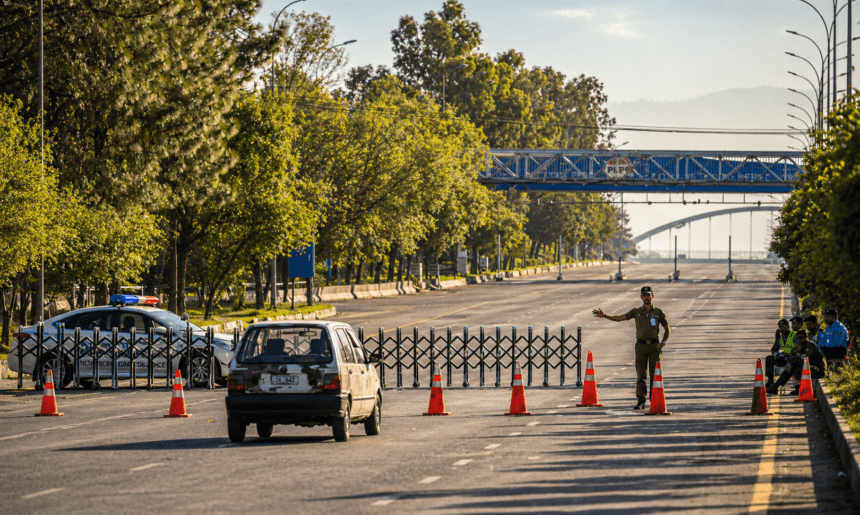
ISLAMABAD, April 25: Islamabad’s Red Zone remained under unusually tight security on Saturday as a high-level Iranian delegation led by Foreign Minister Abbas Araghchi visited the Pakistani capital for talks with senior leadership, prompting road closures, barricades and a heavy police presence across the city’s most sensitive administrative zone.
Police were deployed in large numbers on key arteries leading into the Red Zone, while access to several routes was restricted as part of an expanded security plan for the visit. Visual reporting from the area showed roads sealed with barriers and officers stationed at major intersections, underscoring the level of caution authorities attached to the Iranian delegation’s presence in Islamabad.
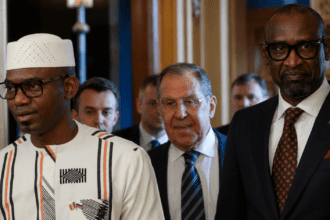
Pakistan’s Foreign Office had announced ahead of the visit that Araghchi was arriving for a two-day official trip and was scheduled to meet Prime Minister Shehbaz Sharif and Deputy Prime Minister and Foreign Minister Ishaq Dar. According to the ministry, the discussions were expected to cover both Pakistan-Iran bilateral relations and the broader situation in the Middle East — a regional crisis that has pushed Islamabad into a more active diplomatic role than usual.
The security lockdown did not unfold in a vacuum. It came at a moment of intense diplomatic movement around efforts to calm tensions involving Iran and the United States, with multiple international reports saying Islamabad had again become a channel for indirect contact and consultation. The Associated Press reported that the Pakistani capital was under tight security as diplomatic efforts continued, while other reporting said U.S. envoys were also expected in Pakistan as part of wider attempts to revive negotiations.
That broader context helps explain why a visit that might otherwise have been treated as a routine diplomatic engagement drew such visible security measures. In recent days, Pakistani authorities had already moved to seal parts of the Red Zone and put in place special traffic arrangements for foreign delegations, with local reporting saying thousands of police personnel, commandos and snipers were assigned for protection duties linked to high-level arrivals in Islamabad.
For residents, though, the immediate reality was far simpler and more frustrating: disrupted movement, rerouted traffic and another day of uncertainty in a city that has repeatedly found itself at the center of regional diplomacy. Business Standard reported that the April 25 lockdown was the second such disruption in recent weeks, reflecting how international negotiations are increasingly spilling into everyday life in the capital.
Araghchi’s visit also fits into a wider pattern of recent Pakistan-Iran engagement. Pakistan’s Foreign Office and official government channels have highlighted ongoing contacts between senior officials from both countries, suggesting Islamabad is trying to keep one foot in bilateral diplomacy and the other in the increasingly complicated politics of the wider Middle East.
By Saturday evening, the strongest signal coming out of Islamabad was not just about who had arrived, but what the city’s lockdown seemed to say: Pakistan wants these talks taken seriously, and it is treating the Iranian visit as part of something much bigger than protocol. In the Red Zone, at least, that message was impossible to miss.