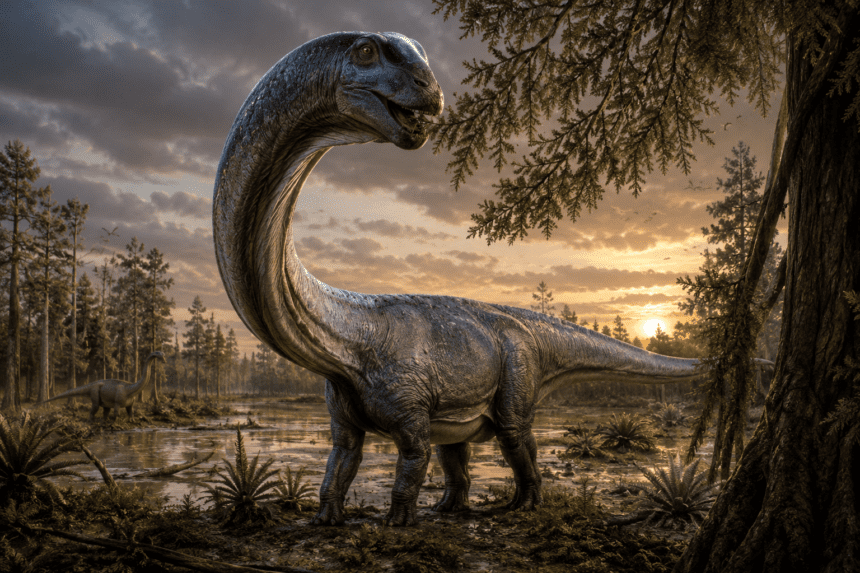
Paleontologists in Thailand have identified a new species of giant sauropod, marking what experts believe is the largest dinosaur ever discovered in Southeast Asia. The find, unearthed in the Phu Wiang district, adds a significant chapter to the region’s prehistoric history.
The dinosaur, named Phuwiang venator yaemniyomi, was identified after years of careful excavation. It belongs to the titanosaur family the long-necked, plant-eating titans that dominated the Cretaceous period. Researchers estimate the creature measured nearly 20 meters in length, making it a behemoth even by sauropod standards.
The discovery began with a local villager who stumbled upon a fossilized bone near a riverbank. That initial fragment led a team from the Department of Mineral Resources to a site that has since yielded a nearly complete skeleton.
“This isn’t just another fossil find; it’s a window into an ecosystem we knew very little about,” said Dr. Somchai Naksri, the lead paleontologist on the project. “Finding a specimen this well-preserved in this specific geological layer is rare.” The sheer scale of the skeleton suggests that Southeast Asia was a far more critical hub for dinosaur evolution than previously assumed.
Until recently, most research on giant sauropods focused heavily on finds in South America and Africa. This discovery shifts the geographic focus, forcing a rethink of how these animals migrated and adapted across the ancient supercontinents. The bones are currently being cleaned and cataloged at the Sirindhorn Museum in Kalasin.
Once the reconstruction is complete, the skeleton will be the centerpiece of a new permanent exhibition, designed to highlight Thailand’s role in global paleontology. For the scientific community, the focus now shifts to the surrounding sediment. Researchers are analyzing the rock layers for pollen and microscopic fossils, hoping to piece together the flora the giant consumed.
The site remains an active dig. As the team continues to peel back the earth, they expect more remains to emerge, potentially revealing how these massive creatures lived—and died—in what is now the heart of Thailand.