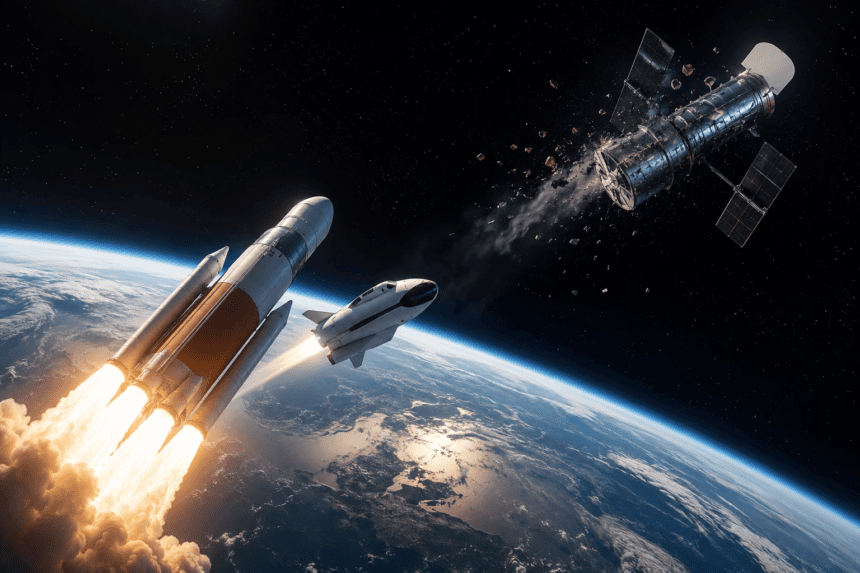
NASA has initiated an urgent recovery mission for the Chandra X-ray Observatory, the agency’s long-standing space telescope currently facing critical hardware degradation. Engineers at the Marshall Space Flight Center are now working to patch aging onboard systems that have begun to falter, threatening the telescope’s ability to maintain its precise orientation in deep space.
The observatory, launched aboard the Space Shuttle Columbia in 1999, has far outlived its original five-year mission expectancy. For two decades, it has provided the most detailed images of black holes, supernovas, and dark matter clusters. Now, the mission is essentially a fight against time and orbital wear.
The immediate crisis stems from a series of anomalies in the telescope’s attitude control system. Sensors designed to track the stars and keep the lens pointed at distant galaxies are showing signs of thermal fatigue. If the telescope loses its “lock” on these guide stars, it will enter an automatic safe mode, effectively drifting into a dark, unmonitored orbit.
“We are managing a machine that was built for the 20th century,” said a lead operations specialist familiar with the recovery efforts. “Every adjustment we make today requires us to account for components that were never designed to be operational in 2024.”
NASA’s strategy involves uploading remote software patches to bypass failing hardware sensors. These “workarounds” are high-stakes; a single error in code could leave the multi-billion dollar platform unresponsive. Ground control teams are currently running simulations on a terrestrial replica of the telescope to test the viability of these fixes before transmitting them to the instrument, which sits roughly 86,000 miles above Earth.
The observatory’s survival is not just about keeping a legacy instrument alive; it is about the data. Chandra remains the only high-resolution X-ray telescope in orbit capable of peering through dense cosmic dust clouds. Losing it now would leave a significant gap in the global astrophysics community’s ability to observe high-energy phenomena, with no immediate successor currently in the pipeline.
While the agency has not set a formal expiration date for the mission, the current hardware struggles signal that the window for meaningful scientific output is narrowing. For now, the focus remains on the next series of remote commands—a delicate digital surgery performed from the ground on a machine that has become a cornerstone of modern space exploration.