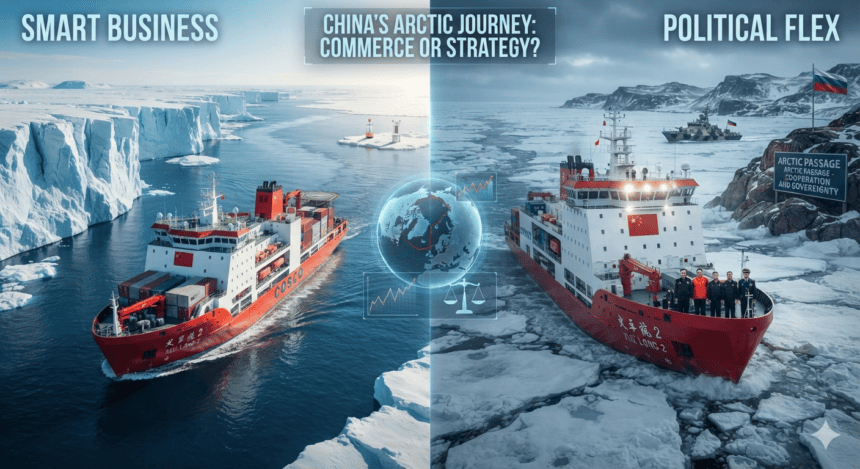
The *Flying Fish 1* didn’t just deliver cargo this month; it sent a message. By navigating the Northern Sea Route (NSR) from Shanghai to St. Petersburg in just over three weeks, the Chinese-operated vessel cut nearly 4,000 miles off the traditional journey through the Suez Canal.
On paper, the math is simple. Shorter distances mean less fuel, lower emissions, and faster turnarounds. But in the high-stakes theater of global trade, the Arctic is never just about math. It’s about who controls the future of the world’s most sensitive shortcut.
Shipping lanes are currently in chaos. With Houthi rebels targeting vessels in the Red Sea and the Panama Canal crippled by drought, the Arctic’s melting ice is offering an icy, albeit controversial, escape hatch. For Beijing, this isn’t a temporary workaround — it’s the realization of the “Polar Silk Road.”
“The economics are starting to outweigh the risks,” says one maritime analyst tracking the route. “When you can save 10 to 15 days on a single trip, the ice doesn’t look so intimidating anymore.”
Yet, the “Smart Business” label only covers half the story.
China’s self-identification as a “Near-Arctic State” has long irritated the Arctic Council, particularly the United States and Nordic nations. By ramping up transits, Beijing is cementing its partnership with Moscow. Russia, which controls the bulk of the NSR’s infrastructure and provides the essential icebreaker escorts, needs Chinese capital to keep its northern ports alive under the weight of Western sanctions.
Washington sees this as more than a trade lane. The Pentagon’s updated Arctic Strategy, released earlier this summer, warned that increased Chinese-Russian cooperation in the region could “alter the Arctic’s stability.” Every Chinese container ship that passes through these waters is seen by some as a trial run for a future military presence.
The hurdles aren’t just political. The Arctic is a logistical nightmare. Deep-water ports are scarce, search-and-rescue capabilities are thin, and the environmental cost of a spill in freezing waters would be catastrophic. Most major Western shipping giants, like Maersk, have stayed away, citing the fragility of the ecosystem.
China doesn’t seem to share those hesitations. For them, the Arctic is a strategic hedge against the “Malacca Dilemma” — the fear that their energy and trade could be choked off at the Malacca Strait during a conflict.
The *Flying Fish 1* voyage proves the route is viable for specialized vessels. Whether it becomes a mainstream highway depends on how much risk the global market can stomach.
For now, the Arctic shortcut remains a high-speed lane for those willing to pay the political price. As one veteran ship captain put it: “The ice is thinning, but the tension is only getting thicker.”